

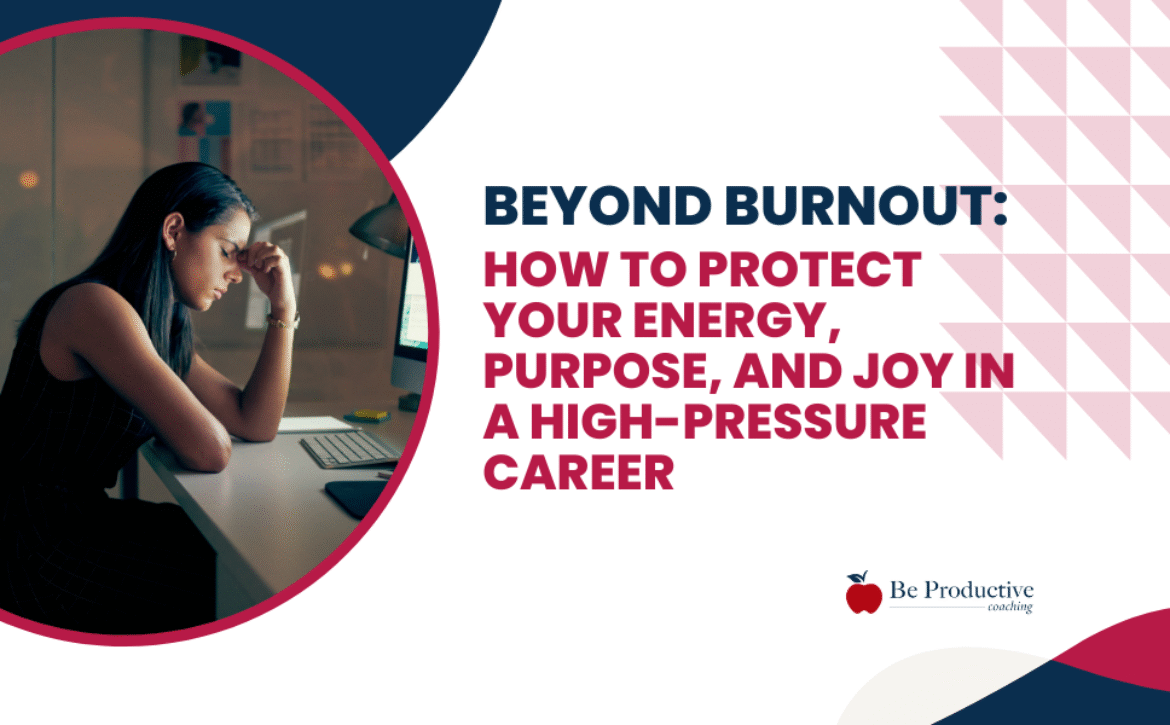
Beyond Burnout: How to Protect Your Energy, Purpose, and Joy in a High-Pressure Career
Beyond Burnout: How to Protect Your Energy, Purpose, and Joy in a High-Pressure Career
Beyond Burnout: How to Protect Your Energy, Purpose, and Joy in a High-Pressure Career
There’s a moment every high-achieving professional eventually faces that quiet, internal signal that something’s off. You’re still showing up, still performing, still caring deeply about your work and the people you serve… but inside, the spark that once fueled your drive feels dimmer.
You tell yourself, “It’s just a busy season.” But deep down, you know it’s more than that.
As a coach who works with senior leaders, executives, and professionals in fast-paced industries, I’ve seen how burnout creeps in subtly, persistently, and often disguised as productivity.
For meeting planners and those in client-centered roles, burnout is especially tricky. You thrive on creating experiences, solving problems, and anticipating everyone’s needs, often at the expense of your own. You pour yourself into every detail, but if you’re not careful, your dedication can cross the line from passion to depletion.
That’s why I recently shared insights with Prevue Meetings in an article on burnout prevention for meeting planners, and I want to take that conversation deeper here.
Because this isn’t just a meeting planner issue. It’s a leadership issue.
It’s a human issue.
And it’s time we start treating burnout not as a badge of honor, but as a signal to realign with what matters most.
What Burnout Really Looks Like
Burnout doesn’t always announce itself through exhaustion. More often, it whispers. It hides behind your calendar, your client calls, your perfectionism, and your desire to deliver at the highest standard.
It shows up as:
- Emotional fatigue masked as “just being tired.”
- Irritability you can’t explain.
- Brain fog during meetings you used to run with clarity.
- Dread toward projects you once loved.
- That constant tug of guilt that says you should be doing more.
Burnout isn’t just a lack of energy; it’s the loss of connection to purpose.
And when you’re in a high-pressure role where people depend on your excellence, that disconnection doesn’t just affect you; it ripples through your team, your clients, and your results.
The good news? Burnout is preventable. But prevention requires awareness, boundaries, and intentional action.
Stop Being a Pleaser
So many talented professionals I coach share a common saboteur: the Pleaser. You know the voice the one that says, “If I make everyone happy, everything will be okay.”
The Pleaser’s intention is good. You want to help. You want to be dependable. But when helping becomes overextending, burnout is inevitable.
When you say yes to every request, you’re not only exhausting yourself, you’re also teaching others to expect your availability at all times.
In my Prevue piece, I shared that setting limits doesn’t make you difficult; it makes you effective. True leadership means discerning when to give your best and when to preserve your best.
Try this: Before you say yes, ask yourself, “Am I saying yes out of alignment or obligation?” That one question alone can shift your energy and clarity.
Boundaries Are Professional, Not Personal
Boundaries are the scaffolding of sustainable success.
Without them, your day never ends. You’re responding to messages at midnight, skipping lunch, or checking emails during family time. Over time, this constant accessibility blurs the line between professional dedication and personal depletion.
Healthy boundaries are not selfish; they’re a form of respect. They communicate to others that your energy, focus, and time have value.
Whether you’re managing events, teams, or clients, be transparent about your availability. Block time on your calendar for deep work. Protect moments of recovery not as luxuries, but as necessities.
As I often tell clients, you can’t pour from an empty cup, and you can’t lead from a place of depletion.
The Power of a Graceful “No”
There’s power in saying no, but there’s even more power in saying it with grace and clarity.
One of the most liberating things you can learn as a leader is that “no” doesn’t mean failure. It means focus.
A strategic “no” allows you to honor your priorities, protect your capacity, and deliver excellence instead of mediocrity spread thin.
And saying no doesn’t need to be harsh. It can sound like:
- “That’s a great idea, but my current commitments won’t allow me to give it the attention it deserves.”
- “I appreciate the opportunity, but I’ll need to decline to stay aligned with my key goals this quarter.”
When you make decisions through the lens of impact rather than impulse, you reclaim your leadership power.
Perfectionism Is the Enemy of Progress
Perfectionism often hides behind professionalism.
It convinces you that if everything isn’t flawless, you’ve failed. But here’s the truth: perfectionism is not about high standards, it’s about fear. Fear of judgment. Fear of losing credibility. Fear of not being enough.
In event planning and leadership, perfection is an illusion. Something will always go off script a vendor cancels, a client changes direction, or a last-minute tech issue appears.
Excellence, on the other hand, is grounded in adaptability. It’s about doing your best with the resources you have, staying calm under pressure, and trusting that your preparation will carry you through.
Ask yourself: Is this extra stress improving the outcome, or is it just feeding my anxiety? If it’s the latter, it’s time to let go.
Streamline and Simplify
Burnout thrives in chaos.
When your systems are disorganized, your energy gets drained by unnecessary decisions and repeated tasks.
One of the most practical ways to protect your wellbeing is to streamline your workflow.
Create templates for recurring projects. Automate reminders. Use collaborative tools that reduce back-and-forth communication.
In my experience, even small process improvements like shared task boards or checklists can make a big difference.
Remember: simplicity is not laziness. It’s a strategy. Every minute saved from inefficiency is a minute you can invest in creativity, connection, or rest.
Delegate and Trust
Here’s a truth many leaders struggle to embrace: delegation is not giving up control, it’s giving others a chance to grow.
When you delegate effectively, you’re not only reducing your workload; you’re building confidence and capability within your team.
Micromanagement, though often well-intentioned, is one of the fastest paths to burnout. It signals a lack of trust both in others and in your own ability to let go.
Start by identifying tasks that don’t require your unique expertise. Train, empower, and release. Then, resist the urge to step back in and “fix.”
Delegation isn’t about perfection; it’s about progress through partnership.
Prioritize Sel-Care as a Leadership Strategy
Self-care isn’t selfish. It’s one of the most powerful leadership strategies you can practice.
When you prioritize your wellbeing, you set the tone for your team. You model balance, boundaries, and self-respect. You lead from fullness rather than fatigue.
Self-care doesn’t have to mean spa days or vacations (though those help). It’s about the daily habits that recharge your body and mind: sleep, movement, prayer, meditation, or simply moments of stillness.
One of my favorite reminders is: Rest is productive. Because when you rest, you recover clarity, creativity, and emotional intelligence, the traits that make you an impactful leader.
Mental Fitness: Your Inner Burnout Shield
Preventing burnout isn’t just about managing your calendar but also about managing your mind.
This is where mental fitness comes in. Through Positive Intelligence (PQ) coaching, I help leaders identify the inner saboteurs, like the Pleaser, Controller, or Hyper-Achiever, that drive stress and sabotage balance.
When you strengthen your mental fitness, you build the capacity to handle challenges with calm and clarity rather than stress and reactivity.
Imagine being able to:
- Respond to pressure without panic.
- Approach mistakes with curiosity instead of self-criticism.
- Lead your team from empathy instead of frustration.
That’s the power of a resilient mind. It’s not about eliminating stress but transforming how you respond to it.
Reconnecting with Purpose
Burnout often signals disconnection from your purpose, your values, or your sense of meaning.
When you reconnect with your “why,” you reignite the fuel that keeps you moving forward not from obligation, but from inspiration.
Ask yourself:
- Why did I choose this profession?
- What impact do I want to create through my work?
- What kind of leader do I want to be remembered as?
Purpose turns pressure into perspective. It transforms busyness into fulfillment.
And when your work is aligned with meaning, your energy becomes sustainable because it flows from within, not from external validation.
What Resilient Leadership Looks Like
Resilient leaders understand that success isn’t about constant motion; it’s about intentional momentum.
They know when to push and when to pause.
They lead with empathy, communicate transparently, and protect their energy like the valuable resource it is.
When you embody this kind of leadership, you not only prevent burnout you also create cultures of trust, engagement, and balance.
In my coaching practice, I’ve seen teams transform simply because their leaders started prioritizing wellness and presence. When you lead with clarity, you give others permission to do the same.
Protecting Your Energy Is the Foundation of Impact
Your ability to lead, serve, and create depends on your ability to stay grounded.
As shared in my Prevue Meetings article on burnout prevention, avoiding burnout isn’t about doing less it’s about doing what matters with more awareness and balance.
Every choice you make, what you say yes to, what you delegate, how you rest, either fuels or drains your energy.
Start paying attention to the patterns. Notice when your body and mind signal fatigue. Pause before you push through. Reflect before you react.
Because sustainable success isn’t about endurance; it’s about alignment.
You deserve to lead a life where productivity coexists with peace, where ambition aligns with wellbeing, and where joy fuels your success not the other way around.
Lead from Wholeness: Reconnect with Your Passion and Protect Your Power
Take a deep breath.
Think about the version of you who started this career the one full of passion, vision, and purpose. That version is still there, waiting for space to breathe again.
Protecting your energy doesn’t make you less driven; it makes you more powerful.
So, start today.
Say no when you need to.
Rest without guilt.
Lead with clarity and compassion for others and for yourself.
Because when you lead from wholeness, you create impact that lasts.
Let’s Continue the Conversation
If you’re feeling the early signs of burnout or you’re ready to build resilience and balance into your leadership, I’d love to support you.
At Be Productive Coaching, I help professionals and teams strengthen their mental fitness, embrace sustainable productivity, and lead with greater purpose.
Download the FREE CAREER SUCCESS ASSESSMENT to take the first step toward renewed focus, balance, and impact. You can also schedule a free consultation to discuss your results and next steps.