
Beyond Burnout

Beyond Burnout: How to Protect Your Energy, Purpose, and Joy in a High-Pressure Career

Beyond Burnout: How to Protect Your Energy, Purpose, and Joy in a High-Pressure Career

Beyond Burnout: How to Protect Your Energy, Purpose, and Joy in a High-Pressure Career

There’s a moment every high-achieving professional eventually faces that quiet, internal signal that something’s off. You’re still showing up, still performing, still caring deeply about your work and the people you serve… but inside, the spark that once fueled your drive feels dimmer.

You tell yourself, “It’s just a busy season.” But deep down, you know it’s more than that.

As a coach who works with senior leaders, executives, and professionals in fast-paced industries, I’ve seen how burnout creeps in subtly, persistently, and often disguised as productivity.

For meeting planners and those in client-centered roles, burnout is especially tricky. You thrive on creating experiences, solving problems, and anticipating everyone’s needs, often at the expense of your own. You pour yourself into every detail, but if you’re not careful, your dedication can cross the line from passion to depletion.

That’s why I recently shared insights with Prevue Meetings in an article on burnout prevention for meeting planners, and I want to take that conversation deeper here.

Because this isn’t just a meeting planner issue. It’s a leadership issue.
It’s a human issue.

And it’s time we start treating burnout not as a badge of honor, but as a signal to realign with what matters most.

What Burnout Really Looks Like

Burnout doesn’t always announce itself through exhaustion. More often, it whispers. It hides behind your calendar, your client calls, your perfectionism, and your desire to deliver at the highest standard.

It shows up as:

  • Emotional fatigue masked as “just being tired.”
  • Irritability you can’t explain.
  • Brain fog during meetings you used to run with clarity.
  • Dread toward projects you once loved.
  • That constant tug of guilt that says you should be doing more.

Burnout isn’t just a lack of energy; it’s the loss of connection to purpose.

And when you’re in a high-pressure role where people depend on your excellence, that disconnection doesn’t just affect you; it ripples through your team, your clients, and your results.

The good news? Burnout is preventable. But prevention requires awareness, boundaries, and intentional action.

Stop Being a Pleaser

So many talented professionals I coach share a common saboteur: the Pleaser. You know the voice the one that says, “If I make everyone happy, everything will be okay.”

The Pleaser’s intention is good. You want to help. You want to be dependable. But when helping becomes overextending, burnout is inevitable.

When you say yes to every request, you’re not only exhausting yourself, you’re also teaching others to expect your availability at all times.

In my Prevue piece, I shared that setting limits doesn’t make you difficult; it makes you effective. True leadership means discerning when to give your best and when to preserve your best.

Try this: Before you say yes, ask yourself, “Am I saying yes out of alignment or obligation?” That one question alone can shift your energy and clarity.

Boundaries Are Professional, Not Personal

Boundaries are the scaffolding of sustainable success.

Without them, your day never ends. You’re responding to messages at midnight, skipping lunch, or checking emails during family time. Over time, this constant accessibility blurs the line between professional dedication and personal depletion.

Healthy boundaries are not selfish; they’re a form of respect. They communicate to others that your energy, focus, and time have value.

Whether you’re managing events, teams, or clients, be transparent about your availability. Block time on your calendar for deep work. Protect moments of recovery not as luxuries, but as necessities.

As I often tell clients, you can’t pour from an empty cup, and you can’t lead from a place of depletion.

The Power of a Graceful “No”

There’s power in saying no, but there’s even more power in saying it with grace and clarity.

One of the most liberating things you can learn as a leader is that “no” doesn’t mean failure. It means focus.

A strategic “no” allows you to honor your priorities, protect your capacity, and deliver excellence instead of mediocrity spread thin.

And saying no doesn’t need to be harsh. It can sound like:

  • “That’s a great idea, but my current commitments won’t allow me to give it the attention it deserves.”
  • “I appreciate the opportunity, but I’ll need to decline to stay aligned with my key goals this quarter.”

When you make decisions through the lens of impact rather than impulse, you reclaim your leadership power.

Perfectionism Is the Enemy of Progress

Perfectionism often hides behind professionalism.

It convinces you that if everything isn’t flawless, you’ve failed. But here’s the truth: perfectionism is not about high standards, it’s about fear. Fear of judgment. Fear of losing credibility. Fear of not being enough.

In event planning and leadership, perfection is an illusion. Something will always go off script a vendor cancels, a client changes direction, or a last-minute tech issue appears.

Excellence, on the other hand, is grounded in adaptability. It’s about doing your best with the resources you have, staying calm under pressure, and trusting that your preparation will carry you through.

Ask yourself: Is this extra stress improving the outcome, or is it just feeding my anxiety? If it’s the latter, it’s time to let go.

Streamline and Simplify

Burnout thrives in chaos.

When your systems are disorganized, your energy gets drained by unnecessary decisions and repeated tasks.

One of the most practical ways to protect your wellbeing is to streamline your workflow.

Create templates for recurring projects. Automate reminders. Use collaborative tools that reduce back-and-forth communication.

In my experience, even small process improvements like shared task boards or checklists can make a big difference.

Remember: simplicity is not laziness. It’s a strategy. Every minute saved from inefficiency is a minute you can invest in creativity, connection, or rest.

Delegate and Trust

Here’s a truth many leaders struggle to embrace: delegation is not giving up control, it’s giving others a chance to grow.

When you delegate effectively, you’re not only reducing your workload; you’re building confidence and capability within your team.

Micromanagement, though often well-intentioned, is one of the fastest paths to burnout. It signals a lack of trust both in others and in your own ability to let go.

Start by identifying tasks that don’t require your unique expertise. Train, empower, and release. Then, resist the urge to step back in and “fix.”

Delegation isn’t about perfection; it’s about progress through partnership.

Prioritize Sel-Care as a Leadership Strategy

Self-care isn’t selfish. It’s one of the most powerful leadership strategies you can practice.

When you prioritize your wellbeing, you set the tone for your team. You model balance, boundaries, and self-respect. You lead from fullness rather than fatigue.

Self-care doesn’t have to mean spa days or vacations (though those help). It’s about the daily habits that recharge your body and mind: sleep, movement, prayer, meditation, or simply moments of stillness.

One of my favorite reminders is: Rest is productive. Because when you rest, you recover clarity, creativity, and emotional intelligence, the traits that make you an impactful leader.

Mental Fitness: Your Inner Burnout Shield

Preventing burnout isn’t just about managing your calendar but also about managing your mind.

This is where mental fitness comes in. Through Positive Intelligence (PQ) coaching, I help leaders identify the inner saboteurs, like the Pleaser, Controller, or Hyper-Achiever, that drive stress and sabotage balance.

When you strengthen your mental fitness, you build the capacity to handle challenges with calm and clarity rather than stress and reactivity.

Imagine being able to:

  • Respond to pressure without panic.
  • Approach mistakes with curiosity instead of self-criticism.
  • Lead your team from empathy instead of frustration.

That’s the power of a resilient mind. It’s not about eliminating stress but transforming how you respond to it.

Reconnecting with Purpose

Burnout often signals disconnection from your purpose, your values, or your sense of meaning.

When you reconnect with your “why,” you reignite the fuel that keeps you moving forward not from obligation, but from inspiration.

Ask yourself:

  • Why did I choose this profession?
  • What impact do I want to create through my work?
  • What kind of leader do I want to be remembered as?

Purpose turns pressure into perspective. It transforms busyness into fulfillment.

And when your work is aligned with meaning, your energy becomes sustainable because it flows from within, not from external validation.

What Resilient Leadership Looks Like

Resilient leaders understand that success isn’t about constant motion; it’s about intentional momentum.

They know when to push and when to pause.
They lead with empathy, communicate transparently, and protect their energy like the valuable resource it is.

When you embody this kind of leadership, you not only prevent burnout you also create cultures of trust, engagement, and balance.

In my coaching practice, I’ve seen teams transform simply because their leaders started prioritizing wellness and presence. When you lead with clarity, you give others permission to do the same.

Protecting Your Energy Is the Foundation of Impact

Your ability to lead, serve, and create depends on your ability to stay grounded.

As shared in my Prevue Meetings article on burnout prevention, avoiding burnout isn’t about doing less it’s about doing what matters with more awareness and balance.

Every choice you make, what you say yes to, what you delegate, how you rest, either fuels or drains your energy.

Start paying attention to the patterns. Notice when your body and mind signal fatigue. Pause before you push through. Reflect before you react.

Because sustainable success isn’t about endurance; it’s about alignment.

You deserve to lead a life where productivity coexists with peace, where ambition aligns with wellbeing, and where joy fuels your success not the other way around.

Lead from Wholeness: Reconnect with Your Passion and Protect Your Power

Take a deep breath.

Think about the version of you who started this career the one full of passion, vision, and purpose. That version is still there, waiting for space to breathe again.

Protecting your energy doesn’t make you less driven; it makes you more powerful.

So, start today.
Say no when you need to.
Rest without guilt.
Lead with clarity and compassion for others and for yourself.

Because when you lead from wholeness, you create impact that lasts.

Let’s Continue the Conversation

If you’re feeling the early signs of burnout or you’re ready to build resilience and balance into your leadership, I’d love to support you.

At Be Productive Coaching, I help professionals and teams strengthen their mental fitness, embrace sustainable productivity, and lead with greater purpose.

Download the FREE CAREER SUCCESS ASSESSMENT to take the first step toward renewed focus, balance, and impact. You can also schedule a free consultation to discuss your results and next steps.

Find Your Balance Work-Life Integration Secrets for 2025

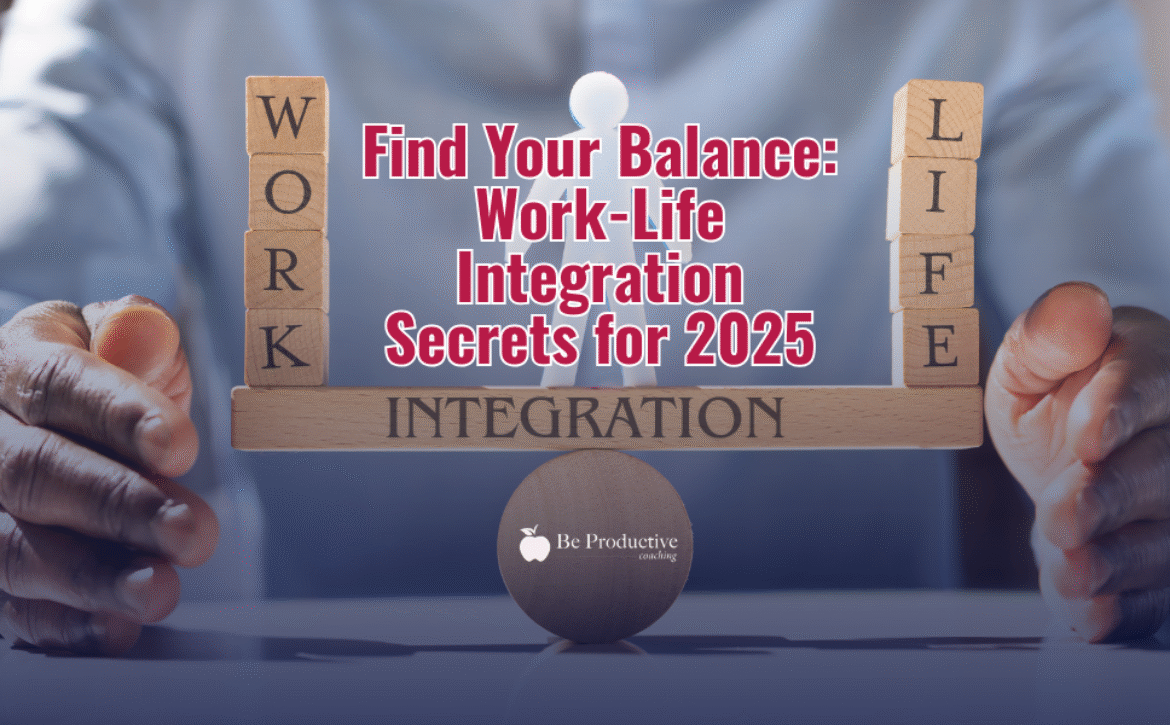
Find Your Balance: Work-Life Integration Secrets for 2025

Find Your Balance: Work-Life Integration Secrets for 2025

Find Your Balance: Work-Life Integration Secrets for 2025

Work-life balance is outdated. In 2025, the lines between work and life are blurrier than ever—and trying to keep them perfectly separate just adds stress. The real goal? Integration—building a life where your work and personal priorities can actually coexist.

What Is Work-Life Integration?

Work-life integration means blending your personal and professional life in a way that feels aligned. Instead of drawing hard lines between the two, you create space for what matters most—when it matters most. It’s fluid, flexible, and realistic.

Why It Matters in 2025

Remote work, digital overload, and constant accessibility have made boundaries harder to keep. Burnout is rising. People are craving purpose and looking for more than just a paycheck—they want fulfillment.

Work-life integration helps you shift from survival mode to sustainability. You’ll feel more present, perform better, and make choices that support both your goals and your well-being.

Master Your Time: Integration Starts with Your Calendar

Time blocking is my secret weapon—and I mean everything goes on my calendar. Work, rest, creative time, even podcast breaks. I learned the hard way that if I don’t protect my time, no one else will.

Here are a few time strategies that work:

  • Prioritize what moves the needle. Not everything is urgent or important.
  • Block your time intentionally. Treat personal time with the same respect as a meeting.
  • Schedule breaks. Walks, naps, or just silence. Rest is fuel.
  • Batch tasks. Avoid constant context-switching. It drains your energy.

Tools like Google Calendar, Trello, or Notion can help—but it’s the discipline to follow your plan that makes the difference.

Build Resilience with Mental Fitness

Work-life integration won’t stick without mental strength. That’s where Positive Intelligence (PQ) comes in.

PQ helps you shift out of stress and reactivity and into calm, focused action. It strengthens your emotional intelligence, improves your relationships, and helps you bounce back faster when life throws a curveball.

Want to build your mental fitness? Start here:

  • Practice 2–3 minutes of PQ reps (like breathwork or sensory mindfulness) daily
  • Notice your stress triggers—and shift your response
  • Protect your energy the same way you protect your time

Tech Can Help—But Only If You Set Boundaries

Yes, technology makes remote work and flexibility possible. But it can also keep you on 24/7 if you’re not careful.

Try this:

  • Turn off nonessential notifications. You don’t need to be available all the time.
  • Schedule screen-free hours. Even one evening a week can help reset your nervous system.
  • Use automation tools like Zapier to free up your brain for what matters.

Create a Culture That Supports Integration

If you’re a leader, your habits set the tone for your team.

Model the integration you want to see:

  • Respect your own time off
  • Encourage flexibility and recovery
  • Be honest about your boundaries (and honor them)

Also, invest in your team’s well-being—whether it’s through wellness programs, mental health support, or just normalizing rest.

Align Your Life and Goals

True integration happens when your personal and professional goals are aligned.

Ask yourself:

  • What does success look like for me this year?
  • Where do my work goals and life goals support each other—or compete?
  • What needs to shift so I feel energized, not drained?

Make time for growth, both in and outside of work. Take a class, revisit an old hobby, or start that podcast idea you’ve been sitting on.

Ready to Integrate? Start with PQ

At Be Productive Coaching, we help high-achieving professionals like you ditch burnout and build habits that actually support your success.

Our next Positive Intelligence Bootcamp kicks off August 15th. It’s the perfect way to end the year strong and set the foundation for a more integrated 2026.

You’ll learn how to:

  • Rewire your brain for focus and resilience
  • Build habits that support your goals—not sabotage them
  • Lead your life with intention, not exhaustion

Let’s Make 2025 the Year You Stop Chasing Balance and Start Living It

Work-life integration isn’t about perfection—it’s about creating a lifestyle that’s sustainable, satisfying, and truly yours. Let’s build that together.

👉 Join the PQ Bootcamp
👉 Book a 1:1 Strategy Call


Why Emotional Health Matters More Than Ever at Work

Why Emotional Health Matters More Than Ever at Work

Why Emotional Health Matters More Than Ever at Work

Why Emotional Health Matters More Than Ever at Work

In our recent blog on the role of respect in workplace well-being, we explored how fostering a respectful culture leads to higher engagement, productivity, and mental well-being. Now, Gallup’s 2024 Global Emotions Report provides new insights into the emotional state of employees worldwide—showing a rebound in positive emotions and a slight decline in negative emotions. This shift carries important lessons for businesses seeking to create emotionally healthy workplaces.

The Emotional Shift: More Positivity, Less Stress

Gallup’s report highlights a significant increase in positive emotions such as enjoyment, laughter, and respect—marking a return to pre-pandemic levels of emotional well-being. Employees who feel respected and valued bring higher energy, focus, and collaboration to their work.

At the same time, negative emotions—like stress, anger, and sadness—have slightly declined. This trend is encouraging, as excessive workplace stress is a leading cause of burnout, disengagement, and turnover. A healthier emotional environment reduces absenteeism, enhances resilience, and strengthens overall team dynamics.

How Emotional Well-Being Fuels Productivity

Gallup’s research confirms what leaders already sense—employees who experience more positive emotions are:

More engaged and motivated to perform at their best

Better at problem-solving and decision-making

 ✔ More collaborative, leading to stronger team dynamics

 ✔ More likely to stay with their organizations, reducing costly turnover

On the flip side, when employees struggle with negative emotions, their ability to concentrate, innovate, and perform declines. That’s why investing in emotional health isn’t just about individual well-being—it’s a business strategy.

How Leaders Can Support Emotional Well-Being

Creating an emotionally healthy workplace starts with leadership. A few impactful ways leaders can contribute include:

Modeling Respectful Communication – Encourage active listening, open dialogue, and recognition of diverse perspectives.

 ✔ Recognizing Contributions – Acknowledge employees’ efforts regularly to boost morale and engagement.

 ✔ Providing Support for Stress Management – Offer mental fitness training and professional development opportunities to help employees navigate challenges.

How Positive Intelligence Can Help

While emotions fluctuate, mental fitness is what helps individuals manage their reactions, build resilience, and maintain a positive, focused mindset at work. This is where Positive Intelligence (PQ) plays a vital role.

By strengthening emotional intelligence, PQ helps employees:

Communicate more effectively – reducing conflict and misunderstandings

Stay calm and focused under pressure – leading to better decision-making

Foster collaboration and innovation – by replacing judgment with curiosity and empathy

When teams undergo our 7-week Positive Intelligence Bootcamp, they experience lasting shifts in mindset, teamwork, and productivity. Organizations that integrate PQ report:

Higher engagement and motivation
Stronger team cohesion and respect
Increased innovation and performance

Join Our Next Positive Intelligence Bootcamp – Starts Aug 15

Invest in your team’s emotional well-being and productivity with our 7-week Positive Intelligence Mental Fitness Bootcamp.

📅 Starts Aug 15 | Sign up Aug 8 to receive:
Two complimentary 30-minute coaching calls Post Bootcamp
One year of access to the Positive Intelligence app
A money-back guarantee if you’re unsatisfied after two weeks

Let’s build a workplace where respect, resilience, and collaboration thrive.

📩 Contact Be Productive Coaching to register or learn more!

Beyond Strategy Mental Fitness Habits That Fuel Sustainable Leadership

Beyond Strategy: Mental Fitness Habits That Fuel Sustainable Leadership

Beyond Strategy: Mental Fitness Habits That Fuel Sustainable Leadership

Leadership Isn’t Just Strategy—It’s Mental Stamina
As leaders and high-achieving professionals, we’re taught to focus on goals, execution, and results. But here’s what often gets overlooked: the mental resilience required to lead well, especially under pressure. The higher up you go, the more critical it becomes to develop mental fitness habits that fuel clarity, confidence, and consistency. In my work as a Career & Executive Coach, I help professionals build not just leadership skills but the inner strength to lead with intention, adaptability, and composure.

Whether you’re navigating high-stakes decisions, leading through organizational change, or managing burnout, mental fitness is what gives you the stamina to lead with integrity and impact. Let’s explore five foundational habits that can help reset and recharge your leadership mindset.

1. Start with a Mental Warm-Up (Before You Open Email)

Your morning routine sets the tone for your leadership energy throughout the day. Instead of diving into email or meetings the second you start work, take 5–10 intentional minutes to anchor your mind and reset your internal compass. This can include:

  • Deep breathing or box breathing exercises (inhale for 4, hold for 4, exhale for 4, hold for 4)
  • Visualizing a calm, confident version of yourself handling the day’s key challenges.
  • A short journaling prompt: “What kind of leader do I want to be today?”

Think of this as your leadership warm-up—like stretching before a workout. It helps you move through your day with more purpose and less reactivity.

2. Reframe Stress into Data

Stress is inevitable at senior levels—but how you interpret it is optional. High-performing professionals often internalize stress as a personal failure. But what if stress is simply feedback? A signal that something’s misaligned?

Instead of suppressing or overanalyzing stress, use this quick mental model:

  • Pause: Acknowledge the emotion without judgment.
  • Label: Name what you’re feeling (e.g., overwhelmed, frustrated, anxious).
  • Ask: “What is this emotion trying to tell me? What might need to change?”

By shifting from emotion to inquiry, you create space for strategic thinking instead of spiraling into overdrive. Stress becomes a cue, not a crisis.

3. Set Boundaries Like a CEO

You don’t need to be available all day to prove your leadership value. In fact, protecting your energy is part of your role as a strategic leader. Boundaries are not about withdrawal—they’re about focusing your effort where it matters most.

Here are a few boundaries that high-performing leaders I coach commonly adopt:

  • No meetings before 10 am to allow for strategic planning, focused work, or personal wellness 
  • A digital sunset: logging off Slack, email, or Teams by 7pm
  • Time-blocking for reflection and long-range thinking
  • Clear communication with team members on when and how to escalate issues

Boundaries model leadership discipline. They also give your team permission to respect their own energy—which ultimately drives better results.

4. Build Micro-Recovery Into Your Calendar

Many executives treat their calendar like a game of Tetris—stacking blocks of productivity without building in breathing room. The problem? Without rest, decision-making becomes reactive, creativity dips, and emotional regulation plummets.

Start scheduling short recovery rituals between blocks of intense work or meetings. Some ideas:

  • A 10-minute walk outside between back-to-back Zooms
  • Listening to calming music while closing your eyes
  • A few minutes of mindful breathing or stretching at your desk
  • A “transition pause” after work to decompress before shifting into home life

Micro-recovery isn’t laziness. It’s brain optimization. These small moments create cognitive space that fuels sharper thinking and emotional regulation.

5. Don’t Go It Alone: Build a Trusted Inner Circle

One of the biggest misconceptions about leadership is that you have to carry the weight alone. The truth? Even top-performing leaders need trusted spaces to decompress, reflect, and gain perspective.

Your inner circle might include:

  • An executive coach who challenges your blind spots and helps realign your goals
  • A peer mentor you can have honest, non-performative conversations with
  • A mastermind group or leadership forum where shared wisdom keeps you grounded

These connections aren’t just emotional support—they’re strategic assets. They help you course-correct faster, build resilience through shared experience, and stay anchored during turbulent times.

Build Inner Strength to Lead with Impact

Leadership in 2025 and beyond isn’t about having all the answers—it’s about cultivating the mental strength to navigate uncertainty, stay centered, and lead from a place of calm confidence. These five mental fitness habits aren’t about adding more to your to-do list. They’re about refining how you show up.

Start with one habit this week. Build consistency. Reflect on what shifts for you.

If you’re a senior leader, executive, or high-performing team member feeling the weight of nonstop pressure—know this: resilience can be built. Confidence can be restored. And your next level of leadership can be one rooted in strength, clarity, and intention.

Need help building a reset plan that aligns with your leadership goals? Let’s connect and co-create your executive edge.

Let’s Work Together

I help high-achieving professionals strengthen their leadership, overcome burnout, and navigate transitions with clarity and purpose. Book a consultation or learn more at Be Productive Coaching.

March banner newsletter ’25

From Sharp to Foggy and Back Again: Reclaiming My Mind

From Sharp to Foggy and Back Again: Reclaiming My Mind

I am beyond honored to introduce the very first guest contributor to the Be Productive Coaching Blog—someone who has been part of my life since childhood and whose journey embodies resilience, transformation, and purpose.

This article is written by my childhood best friend, Inez (Neza) Camacho. Neza and I have known each other since we were 12, and a few years ago, I had the privilege of coaching her through a major career transition. She was at a crossroads, looking for a new direction that aligned with both her talents and her deeper purpose. At the time, she had already been in recovery for a while, and through our work together, we discovered that her next step was to give back—to help others in their own recovery journeys.

Once we identified the right path, Neza pursued a certification in addiction recovery coaching, deepening her expertise beyond personal experience to truly understand the science of healing. After completing her program, we worked together to refine her resume, ensuring it spoke directly to her new career direction—one of the most important steps in making a successful transition. That process, which I guide many of my clients through, is about more than just updating a resume; it’s about aligning identity, purpose, and professional branding to create real impact.

This work is deeply connected to my passion for Positive Intelligence and the brain’s ability to rewire itself. Understanding how we can strengthen new neural pathways, shift mindset patterns, and cultivate resilience is key to both personal and professional transformation. Neza’s story is a testament to this—showing how neuroplasticity, intention, and support can create lasting change.

I chose Neza as our first featured guest for many reasons. Of course, there’s the personal connection—she’s my oldest best friend. But more importantly, the work she does is vital. In a world where mental health struggles are increasingly prevalent, many turn to substances as a way to numb pain, escape reality, or cope with life’s pressures. As someone who made the personal decision to stop drinking in 2022—not because I hit rock bottom, but because I realized it no longer served me—I deeply relate to the themes of clarity, healing, and reclaiming control over one’s life. Since making that decision, I have experienced firsthand the cognitive and emotional benefits of sobriety, from improved memory to greater presence and self-awareness.

Neza’s journey—from struggling with memory loss due to substance use to becoming a guide for others in recovery—is truly inspiring. I am incredibly proud to share her insights on neuroplasticity, healing, and transformation.

Without further ado, I invite you to read below for “From Sharp to Foggy and Back Again: Reclaiming My Mind” by Inez (Neza) Camacho. Her story and expertise are sure to inspire anyone looking to overcome personal challenges, rewire their mindset, and step into a life of clarity and intention.

From Sharp to Foggy and Back Again: Reclaiming My Mind

I woke up on the couch, still in the same clothes from the night before. Confused, I turned to my (now ex) partner and asked, “How did I end up here?” This was my reality more times than I could count. After a night of drinking and smoking marijuana—“drugging,” as I called it—my memories were often fragmented, like a jigsaw puzzle with missing pieces. Sometimes, someone would fill in the blanks, but usually, I was left trying to reconstruct the night on my own.

In 2014, I embarked on my wellness journey. It was only through old pictures, resumes, letters, emails, and the memories of others that I was able to access my past. Even then, not all memories returned. I became obsessed with understanding what had happened to me, why my mind had been so clouded, and, more importantly, how I could reverse the damage. Little did I realize at the time that my use of drugs and alcohol had been an attempt to numb my emotional pain. But as I began my healing process, I discovered something powerful: the brain’s remarkable ability to repair itself through neuroplasticity.

Neuroplasticity is the brain’s capacity to reorganize itself by forming new neural connections throughout life. This adaptability allows us to recover from injury, learn new skills, and reshape thought patterns. For those in recovery, whether from addiction, trauma, or illness, harnessing neuroplasticity can be a game-changer. I discovered I could rewire my brain and restore my cognitive function by implementing intentional habits.

How I Rebuilt My Brain: Strategies for Creating New Neural Pathways

For me, every practice always started with a prayer to my God, and at first, it was for peace.

1. Mindful Repetition & Consistency

  • Engaging in positive habits daily—such as meditation, journaling, and exercise—helped strengthen new neural pathways and replace old destructive behaviors.

2. Physical Movement & Exercise

  • Walking, dancing, and yoga improved my overall well-being and stimulated neuroplasticity. Exercise boosts BDNF (Brain-Derived Neurotrophic Factor), which enhances cognitive function and memory.

3. Meditation & Breathwork

  • Mindfulness meditation reduced my stress and rewired my emotional responses. Breathwork activated my parasympathetic nervous system, helping me cultivate inner peace.

Learning New Skills

  • Challenging my brain by learning new things—such as playing an instrument, gardening, and writing—helped create new neural connections and kept my mind sharp.

5. Journaling & Affirmations

  • Writing about my experiences allowed me to reframe my thoughts, break negative cycles, and reinforce self-empowering beliefs.

6. Social Connection & Community

  • Surrounding myself with a supportive community helped keep me accountable and fostered emotional resilience. Conversations with others shifted my perspective and reinforced positive habits.

7. Healthy Nutrition & Supplements

  • Fueling my body with brain-boosting nutrients like Omega-3s, Vitamin D, magnesium, and B vitamins significantly improved my cognitive function and mood.

8. Gratitude & Visualization

  • Practicing gratitude daily shifted my focus toward positivity, while visualization techniques helped me embody new, healthier habits.

9. Cognitive Reframing

  • By identifying and replacing limiting beliefs with constructive thoughts, I changed my inner dialogue and cultivated self-compassion.

10. Cold Exposure & Novel Sensory Experiences

  • Cold showers and grounding exercises (such as walking barefoot on grass) stimulated my brain, encouraging flexibility and resilience.

After ten years of being substance-free, I can proudly say that my memory is sharper than ever. I integrated these practices gradually—some weekly, some monthly, and others yearly—allowing my brain and body the time they needed to heal. Meditation, breathwork, continuous learning, and a loving, accountable community have been my greatest blessings.

My biggest teacher? My son. He often reminded me of the lessons I had taught him, and when I asked where he had learned them, his response always brought a smile to my face: “From you, Mom.”

Thank you for reminding me, my sweet guru.

Healing is possible. The brain can rebuild. And life, once foggy, can become crystal clear again.

About Inez
Neza – Life, Recovery, Professional & Transformational Coach

Having walked the path of recovery herself, Neza understands the deep challenges that come with rebuilding life, whether from addiction, transitions, or personal setbacks. With compassion and experience, she helps others define what joy and purpose look like for them, guiding them through roadblocks and onto a clearer path.

As a single parent, she knows the delicate balance of parenting in recovery, and as a coach, she supports clients navigating the stress of returning to work, school, or simply finding stability. Neza’s approach is rooted in kindness, resilience, and a touch of adventure, meeting each person where they are and walking beside them on their wellness journey.

Find her on at Nezacoaching.com or @nezacoaching | Linktree

Join Our Newsletter

The Role of Respect in Workplace Well-Being

The Role of Respect in Workplace Well-Being

The Role of Respect in Workplace Well-Being

Respect isn’t just about being polite—it’s the foundation of a thriving workplace. I recently experienced firsthand how a lack of respect for communication and collaboration can disrupt a team’s ability to function effectively.

A Lesson in Respect from a Volunteer Ministry

This January, I spent the month in North Carolina working remotely while my husband was on assignment. In addition to my work, I volunteer at my parish and lead a women’s ministry. Since I was away, I continued to lead our weekly meetings via Zoom. One week, due to a business conflict, I asked two of the women to take over different responsibilities—one to lead the spiritual reflection and the other to coordinate an upcoming fundraising event.

While the spiritual reflection went smoothly, the fundraiser planning quickly spiraled into chaos. Instead of a productive discussion, it became a power struggle. People spoke over one another, different ideas clashed without compromise, and ultimately, the meeting ended with frustration and unresolved tensions.

After speaking with a few of the women afterward, I realized the core issue: there was no respectful exchange of ideas—just individuals pushing their own agendas. This experience made me reflect on how respect plays a crucial role not just in volunteer organizations, but also in the workplace.

In the workplace, respect goes beyond civility—it’s about valuing others’ contributions, listening actively, and fostering collaboration. When employees feel respected, they experience greater psychological safety, engagement, and productivity. On the other hand, workplaces that lack respect see more conflicts, lower morale, and reduced innovation.

According to Gallup’s State of the American Workplace Report, employees in environments where they feel respected are:
✔ More likely to experience better mental health and job satisfaction
✔ Less likely to feel burned out or disengaged
✔ More inclined to stay engaged, show initiative, and contribute to company goals

This reinforces that respect isn’t just a “nice-to-have” but a business imperative that directly impacts employee retention, performance, and overall workplace culture.

Building a Respectful Workplace Culture

Creating a respectful culture starts at the top. Leaders must model respect in their interactions, setting a precedent for the entire organization. This involves clear policies, consistent behavior, and a genuine commitment to valuing every team member.

Here are actionable steps leaders can take to foster respect:

Model respectful behavior – Demonstrate respect in all interactions, from how you listen to how you respond.
Promote active listening – Encourage employees to listen to each other, validating different perspectives.
Recognize achievements – Regularly acknowledge the contributions of team members and celebrate successes.
Encourage open communication – Create channels for employees to voice concerns, ideas, and feedback.
Provide continuous learning opportunities – Offer training on respect, diversity, and inclusion to ensure that respect is consistently reinforced across the organization.

When leaders prioritize respect, it creates a ripple effect—shaping a work environment where employees feel heard, valued, and empowered to collaborate effectively.

How Positive Intelligence Strengthens Respect and Teamwork

One of the most effective ways to enhance workplace respect is by strengthening emotional intelligence (EQ)—and that starts with Positive Intelligence (PQ).

PQ helps individuals recognize and shift away from negative, reactionary thinking (Saboteurs) and instead activate their Sage Powers—such as empathy, curiosity, and innovation—leading to:

Better Communication – Employees become better listeners and more open to feedback.
Stronger Collaboration – Teams work together rather than against each other.
Increased Innovation – A culture of respect fosters creative problem-solving.

By improving mental fitness, Positive Intelligence helps leaders and teams build a foundation of respect that leads to higher workplace well-being, engagement, and productivity.

Join Our Next Positive Intelligence Bootcamp – Starts March 1st!

If you’re looking to strengthen emotional intelligence, communication, and collaboration in your workplace, our 7-week Positive Intelligence Mental Fitness Bootcamp is for you.

📅 Starts March 1st | Sign up by February 17th to receive:
Two complimentary 30-minute coaching calls
One year of access to the Positive Intelligence app
A money-back guarantee if you’re unsatisfied after two weeks

Transform the way you lead and interact—starting with your own mental fitness. Let’s build a workplace (and life) where respect, collaboration, and well-being thrive.

📩 Contact Be Productive Coaching to register or learn more!

Unpacking Job Hate: Is It You, Them, or the System?

Unpacking Job Hate: Is It You, Them, or the System?

Unpacking Job Hate: Is It You, Them, or the System?

Job dissatisfaction has become alarmingly common, affecting professionals across industries and career stages. A recent Gallup survey revealed that nearly 60% of workers feel emotionally detached from their jobs, and 19% are downright miserable. Why is this the case? Why do so many people dislike their jobs, and how can they address this frustration? Are you part of this statistic?

Understanding the root of job dissatisfaction is key to finding solutions. The reasons often fall into three categories: internal factors (your mindset and expectations), workplace dynamics (your relationships and environment), and systemic issues (broader cultural and economic forces).

Why Do People Hate Their Jobs? Before exploring solutions, it’s essential to understand the factors that lead to widespread job dissatisfaction. Common reasons include:

  • Lack of Meaning or Purpose: Many employees feel their work needs to be more significant and connected to their values, leaving them unfulfilled. Without a sense of purpose, even high-paying roles can feel dissatisfying.
  • Toxic Work Environments: Workplace toxicity, including office politics, poor leadership, or lack of recognition, can lead to frustration and burnout.
  • Unrealistic Demands: The modern obsession with productivity often results in heavy workloads, long hours, and little room for balance, leaving workers drained and resentful.
  • Stagnation: Professionals often prefer to avoid their jobs when they feel stuck in a role without growth opportunities. A lack of challenges or skill-building prospects can lead to disengagement.
  • Economic Pressures: Low wages, job insecurity, or the constant need to “hustle” can create stress and dissatisfaction. For many, jobs feel more like a financial necessity than a fulfilling career path.

Recognizing these common issues is the first step in addressing job dissatisfaction. Let’s explore how internal, relational, and systemic factors contribute to these challenges.

The Internal Perspective – Is It You? Sometimes, dissatisfaction originates from within. Your mindset, values, and expectations play a significant role in shaping how you experience work.

Career misalignment is a leading internal cause. If your job doesn’t align with your passions or goals, it’s natural to feel frustrated. Additionally, unrealistic expectations—assuming every workday will be fulfilling—can amplify dissatisfaction when reality doesn’t meet these standards.

Burnout is another internal factor. Emotional exhaustion from prolonged stress can make even routine tasks feel insurmountable, causing negative feelings to snowball.

Workplace Dynamics – Is It Them? For many, dissatisfaction stems from workplace culture and relationships. No matter how meaningful the work is, a toxic environment can erode morale.

Poor leadership is one of the biggest culprits. A disengaged or micromanaging boss can create a frustrating atmosphere, while a lack of recognition or unclear communication can make employees feel undervalued. Similarly, unresolved conflict with colleagues can add to daily work stress.

  • Communicate openly: Have a candid conversation with your manager about expectations, growth opportunities, or concerns.
  • Learn conflict resolution skills: Approach workplace disagreements with a focus on finding solutions rather than assigning blame.
  • Evaluate the culture fit: If the organization’s values don’t align with your own, it might be time to consider a new role or workplace.
  • Invest in your mental fitness: Strengthen your ability to tackle workplace challenges with calm focus instead of stress or self-sabotage. Enroll in a 7-week Positive Intelligence (PQ) Bootcamp to master the PQ operating system, which enhances mental agility, reduces negative self-talk, and boosts problem-solving skills.

The Systemic Reality – Is It the System? In many cases, dissatisfaction is driven by forces beyond individual control. The broader system—marked by relentless productivity demands, stagnant wages, and a glorified “hustle” culture—often leaves employees feeling overworked and undervalued.

Societal expectations also play a role. The notion that success equals constant grind and sacrifice creates a work environment where balance and well-being are deprioritized. Economic pressures, such as the rising cost of living and job insecurity, exacerbate these challenges.

  • Adapt to systemic limitations: Look for companies offering flexible schedules, remote work options, or strong mental health initiatives.
  • Advocate for change: Join efforts to improve workplace policies, like pushing for better benefits, wellness programs, and psychological safety.
  • Explore alternatives: If the system feels unchangeable in your current role, consider pivoting to a more supportive industry or organization.

Transform Your Career: Take the First Step Toward a More Fulfilling Career Today!

Hating your job isn’t just frustrating—it can impact your mental health, relationships, and long-term career prospects. By examining whether the problem lies within you, your workplace, or the broader system, you can begin to take actionable steps toward change. Job satisfaction is possible with the right strategies and support.

At Be Productive Coaching, we specialize in guiding professionals through these challenges. Whether you need help realigning your goals, improving workplace dynamics, or considering a career shift, we support you. Contact us today to take the first step toward a more fulfilling professional life.

Don’t let job dissatisfaction follow you into 2025! Join our 7-week Positive Intelligence (PQ) Bootcamp starting on January 11th and receive 25% off when you register by December 23, 2024. Learn how to address workplace challenges with calm, focus, and mental clarity instead of frustration and self-sabotage. Take control of your career and start the new year with purpose and impact. Reach out to secure your spot today!

Surprising Daily Habits That Could Be Adding to Your Anxiety

Surprising Daily Habits That Could Be Adding to Your Anxiety

Surprising Daily Habits That Could Be Adding to Your Anxiety

In today’s fast-paced world, anxiety has become an everyday companion for many. While we’re aware of the significant stressors like work deadlines or financial worries, it’s easy to overlook the small, seemingly harmless habits that could add to our stress levels. Recognizing these hidden triggers is essential for building a balanced, calm lifestyle. Here, we’ll explore a few of these daily habits that might fuel your anxiety and share how some simple adjustments can make a big difference.

Disclaimer: This article discusses general, everyday anxiety that may come from typical life stressors. If you experience persistent, overwhelming, or medically diagnosed anxiety, please consider consulting a healthcare provider for appropriate guidance and support.

I know it’s tempting to reach for your phone first thing in the morning to scroll through social media or catch up on the news, especially if you are like me and use your phone as your alarm. But while it might feel like a gentle way to wake up, it can kickstart a cycle of stress. Studies show that exposure to social media early in the day can lead to comparison, information overload, and even “doom-scrolling”—a habit linked to increased anxiety.

Instead of starting with your phone, begin your day with a screen-free routine. A few minutes of stretching, deep breathing, or enjoying a quiet cup of coffee can help you set a calm, positive tone for the day.

Personally, I am thankful to have my two dogs, who are attention hounds in the morning. Although I walk to the bathroom to brush my teeth with my phone, my focus is on them and getting my teeth brushed. I also have a morning routine of listening to the daily readings in the Hallow App. So, although I am on my phone, I am being productive with my spiritual practice.

To-do lists are fantastic for staying organized, but there’s a fine line between planning and overwhelming yourself. When we overload our lists, we create pressure to achieve perfection, leading to stress when we inevitably fall short. This constant drive to cross off every task can fuel feelings of inadequacy and, yes, anxiety.

Instead, try limiting yourself to 3-5 critical tasks each day. This approach, known as “priority planning,” keeps you focused on what truly matters, reducing the pressure of an overloaded list and boosting both productivity and peace of mind.

My trick? I schedule everything on my calendar, and there’s only so much space, so I have no choice but to limit myself to 2 or 3 key tasks between client sessions. 

This is a hard one for me to include here because it is my ONLY guilty pleasure. However, I understand how, for some, this may be a stimulant that is not good for you. So, if you are one of those people, you should lay off the caffeine. I know it’s hard because caffeine is a go-to for many in our “always-on” culture, providing that quick boost to keep going. But caffeine stimulates the nervous system, raising heart rate and blood pressure, both of which mimic anxiety symptoms. For some, this can unintentionally amplify feelings of anxiety.

If that’s you, consider switching your second or third cup of coffee for herbal tea or water, especially in the afternoon. Green tea, with its mix of caffeine and the calming amino acid L-theanine, maybe a gentler alternative. Moderating caffeine intake can help maintain energy while keeping anxiety triggers in check.

Busy schedules make skipping meals or grabbing quick, sugary snacks easy. But erratic eating leads to blood sugar dips, making you feel irritable, anxious, and fatigued. Eating high-sugar foods also causes “sugar crashes” that exacerbate anxiety symptoms.

Prioritizing balanced meals with protein, healthy fats, and complex carbs can stabilize blood sugar and improve mood. Setting aside time to eat mindfully—even just 10 minutes—can keep your body and mind balanced. Minor adjustments like meal-prepping, carrying snacks, or ordering from a meal service (my productivity hack) can significantly impact your anxiety levels.

Before I go on, let me tell you about Jet Fuel Meals. My husband and I work from home, and earlier this year, we recognized that our schedules were not allowing meal prepping, so we decided to try out this meal delivery service after a neighbor raved to us about it. Let me just say it’s been four months, and we love it. It saved us time and money, and we no longer skip meals or snacks. Jet Fuel Meals is based in Florida, but you can locate a meal service near you if you are out of the state. 

With remote work and constant connectivity, many people need to be productive all day. But this “always-on” mentality often backfires, leading to mental fatigue, burnout, and increased anxiety. With breaks, our brains can experience much-needed rest, which makes handling stress easier.

Set a timer to take a 5-10 minute break each hour. Stretch, walk around the block, or practice mindfulness to recharge. These small mental breaks can reduce stress, allowing you to return to tasks more focused and refreshed. I love playing with my dogs during my breaks and taking a short walk during my lunch break.

Ignoring Sleep Needs: How Sleep Deprivation Impacts Anxiety

Now, this is a massive boundary for me. Sleep and mental health go hand in hand, yet many of us sacrifice sleep for extra work, screen time, or late-night distractions. Poor sleep lowers resilience, worsens mood, and impairs focus—all of which can heighten anxiety.

Prioritizing sleep is one of the simplest ways to reduce anxiety. Aim for 7-9 hours each night and consider a relaxing bedtime routine. I love my bedtime routine! Avoid screens at least an hour before bed to reduce blue light exposure (I can be better at this), which disrupts melatonin production and can impact sleep quality.

Here is my routine:

I start with a hot shower, go through my facial routine, and brush my teeth. I take one melatonin, put a moisturizer on my feet and a little balm on my lower back, and say my nighttime prayers. I then turn on my white noise machine, put on my silk satin bonnet if my hair is styled, and lastly, put on my Tempur-Pedic Sleep Mask and go to sleep. I love my routine! 

Awareness as Your First Step Toward Change

Being aware of these hidden anxiety triggers is your first step to a healthier, more balanced life. With minor adjustments to your habits, you can make space for calm, focus, and mental clarity in your day-to-day routine. These small changes add up, helping you feel more in control and less anxious.

My last go-to is Ashwagandha.. I am not a doctor, and I am not prescribing this to you, but this natural supplement has been life-changing for my husband and me. It helps balance energy levels, stress relief, and mood. Read about it and ask your healthcare professional if it’s okay for you to take it. 

Start Managing Your Anxiety with Be Productive Coaching

Ready to take the next step toward a balanced, fulfilling life? At Be Productive Coaching, we offer personalized guidance to help you recognize and reduce anxiety triggers, build healthier daily habits, and regain control over your well-being. Through compassionate, expert coaching, we’ll help you develop strategies that fit your unique lifestyle and goals.

Don’t let anxiety dictate your days—reach out today and start creating a foundation for lasting calm and resilience.

Work-Life Integration: Finding Harmony in a Busy World

Work-Life Integration: Finding Harmony in a Busy World

Work-Life Integration: Finding Harmony in a Busy World

In today’s fast-paced business environment, work-life integration has emerged as an essential strategy for individuals striving to harmonize their professional and personal lives. With the lines between work and home increasingly blurred—especially in the era of remote work—understanding how to create harmony in this busy world is vital.

Work-life integration is a progressive approach that emphasizes blending personal and professional responsibilities instead of maintaining a strict separation. Unlike traditional work-life balance, which often suggests a zero-sum game where time spent on one side detracts from the other, work-life integration encourages both realms to coexist and even complement one another.

From my experience coaching professionals navigating this balance, work-life integration is less stressful than work-life balance. It’s important to understand that the goal isn’t achieving a “perfect balance” but instead creating a lifestyle that integrates the complexities of modern life in ways that resonate with your unique priorities. 

Key Concepts:

  • Work-Life Integration: Merging professional and personal life → Achieving harmony in responsibilities → Enhancing overall satisfaction.
  • Work-Life Flexibility: Adapting schedules to accommodate personal commitments → Reducing stress levels → Promoting well-being.

As professionals balance remote work, family obligations, and personal interests, work-life integration becomes helpful and necessary for overall satisfaction and well-being.

The advantages of adopting a work-life integration approach are substantial. Here are a few key benefits:

  • Reduced Stress Levels: Removing rigid boundaries allows individuals to respond more fluidly to the demands of work and home, helping to lower stress.
  • Increased Productivity: Flexible scheduling enables people to work during their peak hours, leading to a natural boost in productivity.
  • Improved Job Satisfaction: Employees who feel supported in integrating their personal lives with professional roles report higher job satisfaction and loyalty.
  • Enhanced Employee Retention: Organizations that foster work-life integration tend to see lower turnover rates, as employees appreciate the flexibility and genuine support for their well-being.

Embracing work-life integration doesn’t mean aiming for perfect balance—it means designing a sustainable lifestyle where work and life flow together naturally, minimizing stress and maximizing overall satisfaction.

Implementing practical strategies for work-life integration is essential for those seeking harmony in a busy world. Here are several actionable approaches:

  • Set Clear Boundaries: While flexibility is key, establishing clear boundaries helps prevent burnout. Designate specific work and personal activities times to ensure each receives the attention it deserves.
  • Utilize Flexible Work Arrangements: Encourage remote work or flexible hours where possible. This adaptability allows people to manage their time effectively, accommodating professional responsibilities alongside personal commitments.
  • Prioritize Tasks: Effective time management is essential for achieving work-life integration. Tools like calendars or task managers can help prioritize tasks based on urgency and importance.
  • Foster Open Communication: Creating an environment where employees feel comfortable discussing their needs fosters a supportive workplace. Open dialogue can help address challenges and reduce unnecessary stress.

These strategies naturally blend work and personal life, contributing to greater satisfaction, productivity, and a more harmonious day-to-day experience.

Creating a workplace culture that promotes work-life integration is crucial for long-term success. Here’s how organizations can foster this environment:

  • Leadership Support: Leaders play a significant role in shaping workplace culture. When leaders prioritize well-being, they set examples like taking breaks or spending time with family that establish a precedent for others.
  • Flexible Policies: Organizations can implement policies supporting various working styles, including options for remote work, flexible hours, or compressed workweeks.
  • Encouraging Well-being Initiatives: Programs supporting mental and physical well-being, like wellness or Positive Intelligence practices, can create a culture that values and promotes holistic health.

When organizations prioritize work-life integration, they see the benefits in happier employees and improved organizational performance.

Learning from other organizations’ success with work-life integration can offer valuable insights:

  • Case Study: Company A

Company A implemented flexible working arrangements during the pandemic, letting employees choose working hours based on peak productivity times. As a result, productivity rose by 25%, significantly improving employee morale.

  • Case Study: Company B

Company B introduced wellness programs focusing on mental health, offering counseling services and stress management workshops. This initiative helped reduce burnout rates and improve job satisfaction.

These examples show that when organizations invest in work-life integration, they create value for employees and the organization.

Achieve Harmony in Work and Life: Start Your Journey with Be Productive Coaching

Navigating the complexities of modern life requires a thoughtful approach to integrating work and personal responsibilities. By embracing principles of work-life integration—setting boundaries, fostering flexibility, and learning from proven success stories—you can find harmony in your busy life.

At Be Productive Coaching, we empower individuals to discover their unique paths toward effective work-life integration. What does harmony look like for you? Contact us today to learn how we can support your journey to more outstanding balance, productivity, and satisfaction.

Networking Made Easy: How to Connect with Confidence and Purpose

Networking Made Easy: How to Connect with Confidence and Purpose

Networking Made Easy: How to Connect with Confidence and Purpose

Have you ever felt like a fish out of water at a networking event? You’re not alone. For many professionals, the mere thought of networking can trigger a cold sweat. But what if I told you that networking could be painless, enjoyable, and incredibly rewarding? Welcome to your guide on “Networking Made Easy: How to Connect with Confidence and Purpose.”

Networking isn’t about collecting business cards like Pokémon. It’s about cultivating meaningful professional relationships that can take your career to new heights. But before you sink in, let’s lay the groundwork:

  • Set Clear Goals: What do you want to achieve? Who do you want to meet? Having a roadmap turns networking from a vague concept into a purposeful mission.
  • Embrace a Growth Mindset: Every interaction is a chance to learn. That awkward silence? It’s just an opportunity in disguise.
  • Open Your Eyes: Networking opportunities are everywhere – from your morning coffee run to your weekend spin class. Stay alert!

I didn’t see myself as a natural networker. In fact, I started my career in sales in 2002 at the Sonesta Beach Resort in Key Biscayne. To be honest, I didn’t see myself as a salesperson either! The only reason I took the position was that the resort’s General Manager recommended it. At the time, I was bored with operations as the Assistant Front Office Manager and wanted to try something new. When I shared this with the GM, he suggested sales. I was surprised by his recommendation, but I trusted his intuition. He believed in me so much that he opened up an opportunity for me as the Small Groups and Corporate Travel Sales Manager. I got the job after applying and interviewing with the Director of Sales and VP of Sales.

A year later, I found myself at my first sales retreat. I’ll never forget it because it was also my first time presenting in front of an audience. Our VP of Sales assigned each of us a topic based on a skill he thought we had perfected, and much to my surprise, he gave me “Networking.” I was caught off guard because, like sales, I hadn’t realized networking was something I was good at. However, after reflecting, I began to see how my networking skills had been naturally developing. I crafted a presentation on networking for my colleagues, which received excellent feedback, and I was proud of how far I’d come.

I realized networking was all about mindset, just like taking the leap into sales. To apply for the sales position, I had to let go of my judgment about what sales was. Likewise, for networking, I had to stop thinking of it as something scary. The fear dissolved once I reframed my approach and realized that everyone was there with a similar goal – to network and build relationships that lead to business.

Feeling jittery about putting yourself out there? Try these confidence boosters:

  • Craft Your Elevator Pitch: Think of it as your professional theme song. It should be short, catchy, and uniquely you.
  • Body Language Hacks: Stand tall, smile genuinely, and offer a firm handshake. This is the only time I will tell you to fake it ’til you make it – your body can trick your brain into feeling more confident.
  • Introvert’s Toolkit: If large crowds make you sweat, seek one-on-one conversations. Quality trumps quantity every time.

In the age of social media, it’s easy to equate success with a high follower count. But networking is all about quality connections. Here’s how to make them:

  • Be Genuinely Curious: Ask thoughtful questions. People love talking about themselves – give them the spotlight.
  • Listen Like Your Career Depends on It: Because it might. Active listening is a superpower in networking.
  • Give Before You Take: Offer value without expecting immediate returns. It’s the long game that pays off.

Now that you’re ready to mingle, let’s polish those skills:

  • Icebreakers That Work: Forget “Nice weather, huh?” Try “What’s the most exciting project you’re working on now?”
  • Navigate Events Like a Pro: Set goals for meaningful conversations, not just hands shaken. Quality over quantity, remember?
  • Follow-Up Finesse: Send a personalized email within 48 hours. This is the most critical step! Reference your conversation and suggest a concrete next step. Remember that most people will not follow up, so this is an excellent way to set yourself apart.

Welcome to Networking 2.0:

  • LinkedIn Makeover: Your profile is your digital handshake. Make it firm and memorable. If you’re unsure how to do this, check out our other blogs, which offer great branding tips.
  • Social Media Strategy: Each platform is a networking goldmine. Choose your playground: Twitter chats, Instagram stories, Facebook groups. Personally, I stick to LinkedIn.
  • Virtual Networking Mastery: With remote work on the rise, perfect your “virtual handshake” and Zoom etiquette. If you’re not sure how to do it, let’s chat!

Like any skill, networking gets better with practice and reflection:

  • Set Networking Metrics: Track new connections, follow-up rates, and opportunities generated. What is measured is managed.
  • Quality Check: Regularly assess your network. Are these connections aligned with your goals?
  • Continuous Improvement: Seek feedback, reflect on interactions, and stay updated on networking trends.

The ultimate goal? Turning the connections into career opportunities.

  • Keep Contacts Warm: Regular check-ins and updates keep you at the top of their mind. Make sure to keep these meaningful.
  • Be a Giver. The more you help others, the more likely they are to think of you when opportunities arise.
  • Clear Communication: When seeking opportunities, be specific about what you want.

Networking isn’t about being the loudest in the room or having the most LinkedIn connections. It’s about building genuine relationships, adding value to others’ lives, and strategically growing your professional circle. With these tools, you can transform networking from a necessary evil into your secret career superpower.

Remember, every great connection starts with a single “Hello.” So, take a deep breath, put on your most approachable smile, and get out there. Your next game-changing opportunity might be just a handshake away.

Ready to improve your networking skills? At Be Productive Coaching, we offer personalized strategies to supercharge your professional connections. Contact us today and watch your network and career soar.