

Showing Up Is Not the Same as Being Prepared

Showing Up Is Not the Same as Being Prepared

Showing Up Is Not the Same as Being Prepared

There is a moment in every interview that reveals more than any resume ever could. It is not when the candidate answers a question correctly. It is not when they share an impressive achievement. It is not even when they articulate their career aspirations with clarity.

The moment I am talking about happens earlier. It is the moment the candidate walks into the room, or logs into the video call. It is the energy they bring. It is the presence they project. It is the subtle but unmistakable signal they send about who they are and how they show up.

I have sat on both sides of the interview table. As a coach, I have prepared countless professionals for high-stakes interviews. And I have observed one pattern consistently. The candidates who succeed are not always the most qualified. They are the ones who show up fully present, grounded, and intentional.

This is not about having the perfect answers. It is about something deeper. It is about fulfilling the promise of who you say you are through how you show up in the moment.

The Gap Between Preparation and Presence

Most professionals invest significant time in interview preparation. They research the company. They practice their answers. They prepare questions to ask. They rehearse their talking points until they feel confident and ready.

This is all valuable. But it is also incomplete.

Preparation gets you ready to perform. It gives you the content you need to answer questions and demonstrate your capability. But performance is not the same as presence.

Presence is the quality of being fully engaged in the moment. It is the ability to connect with the person across from you. It is the capacity to listen, respond, and adapt in real time rather than delivering rehearsed answers.

Many professionals confuse preparation with presence. They think that if they have prepared enough, they will automatically show up well. But preparation without presence can feel robotic, scripted, and disconnected. The candidate may say all the right things, but something feels off.

The interviewer is not just evaluating your answers. They are evaluating you. They are asking themselves, “Do I trust this person? Do I want to work with them? Do they have the judgment and emotional intelligence to succeed in this role?”

Your answers matter. But how you show up matters more.

What Showing Up Really Means

Showing up is not about being polished or perfect. It is about being real. It is about bringing your full self to the interaction, not just the curated version you think the interviewer wants to see.

Showing up means being present. It means listening more than you speak. It means responding to what is actually being asked rather than pivoting to the answer you prepared. It means being curious about the interviewer, the organization, and the role rather than just trying to sell yourself.

Showing up means being grounded. It means managing your nerves so they do not manage you. It means breathing through the discomfort of being evaluated. It means trusting that your capability will come through if you stop trying so hard to prove it.

Showing up means being authentic. It means letting your personality show. It means being honest about what you know and what you do not know. It means showing curiosity, humility, and a genuine interest in the work and the people.

This is what separates candidates who are simply prepared from candidates who truly show up. Preparation gets you through the interview. Presence gets you the offer.

The Energy You Bring

There is something intangible that happens in every interaction. It is the energy you bring into the room. It is the feeling people get when they are with you. It is the impression you leave behind when you are gone.

In an interview context, this energy matters enormously. Interviewers are not just assessing your skills and experience. They are assessing whether they want to work with you. They are asking themselves if you are someone they can trust, collaborate with, and see themselves spending significant time with.

Your energy communicates this before you say a single word. It is in the way you enter the room. It is in your posture, your eye contact, your tone of voice. It is in the quality of your attention and the sincerity of your engagement.

Candidates who show up with nervous, scattered energy signal instability. Candidates who show up with rehearsed, performative energy signal inauthenticity. Candidates who show up with grounded, present energy signal trustworthiness.

The interview is not just about whether you can do the job. It is about whether you are someone others want to work with. And that judgment happens at a level deeper than logic.

What Fulfilling Your Promise Looks Like

Your resume makes a promise. It says you are capable, accomplished, and ready for the next step. It creates an expectation about who you are and what you bring.

Showing up is about fulfilling that promise. It is about aligning your presence with the expectations your resume and reputation have created.

When you walk into an interview, the interviewer already knows about your qualifications. They have seen your resume. They have read your LinkedIn profile. They have a sense of what you can do.

What they do not know is who you are. They do not know how you communicate, how you handle pressure, or how you engage with others. They do not know if you are someone they can trust and respect.

This is what the interview is actually for. It is not to prove your qualifications. It is to demonstrate that the person on paper is the same person in the room.

Fulfilling your promise means your presence matches your credentials. It means your energy aligns with your accomplishments. It means you show up as someone who not only has the skills but also has the judgment, emotional intelligence, and presence to lead.

The Interview as a Mirror

One of the most valuable perspectives I share with clients is this. The interview is not just about whether you get the job. It is also a mirror. It reflects how you show up in moments of pressure and uncertainty.

How you prepare for an interview reflects how you prepare for important work. How you handle nerves reflects how you handle stress on the job. How you engage with the interviewer reflects how you will engage with colleagues and stakeholders.

If you show up scattered and unprepared, that is a signal. If you show up defensive and overly rehearsed, that is a signal. If you show up grounded, present, and authentic, that is also a signal.

The interview reveals patterns that go beyond the specific role. It reveals how you operate under pressure. It reveals your self-awareness. It reveals your emotional intelligence.

This is why interview preparation is not just about practicing answers. It is about developing the presence and self-awareness that will serve you throughout your career.

The Energy of Presence

Here is what showing up with presence looks like in practice.

You arrive early enough to settle yourself. You take a few breaths before you enter. You are not rushing or frazzled. You are not running through talking points in your head. You are calm and present.

You make eye contact. You smile. You connect with the interviewer as a person, not just as a gatekeeper. You are genuinely curious about them and their experience.

You listen more than you speak. When you do speak, your answers are thoughtful and responsive. You are not delivering prepared monologues. You are engaging in a conversation.

You are comfortable with silence. You do not feel the need to fill every gap. You pause before answering. You think before you speak. You communicate thoughtfulness and composure.

You are honest about what you do not know. You do not pretend to have expertise you do not possess. You acknowledge gaps with curiosity and a willingness to learn.

You leave the interview feeling like you showed up as yourself, not as a version of who you think they want to see.

This is not about being perfect. It is about being real. It is about being present. It is about fulfilling the promise of who you are through how you show up.

A Coach Story

I once worked with a professional who was technically brilliant but struggled to convert interviews into offers. She had an impressive resume, deep expertise, and a track record of delivering results. Yet time after time, she would make it to the final round and then get passed over.

When we reviewed her interview approach, a pattern emerged. She was so focused on having the perfect answer that she was not really present in the conversation. She was listening with the intent to respond, not with the intent to understand. She was delivering prepared content, not engaging in a genuine dialogue.

We shifted our preparation. Instead of just practicing answers, we practiced presence. We worked on grounding techniques to manage her nerves. We practiced active listening and thoughtful responding. We worked on showing up as herself, not as a performer.

The next interview she had, she walked in with a different energy. She was calm, present, and engaged. She connected with the interviewer. She listened. She responded thoughtfully.

She got the offer.

Her qualifications had not changed. Her presence had.

The Professional Wellness Connection

This may seem unrelated to professional wellness, but it is not. How you show up in high-pressure moments like interviews is a reflection of your overall well-being.

If you are constantly stressed, overwhelmed, and reactive, that will show up in interviews. If you are not taking care of yourself, if you are burned out or depleted, your energy will reflect that.

Professional wellness is not just about reducing stress. It is about developing the capacity to show up fully in moments that matter. It is about building the mental fitness to be present, grounded, and intentional even under pressure.

This is why mental fitness practices matter. They help you manage your internal state so you can show up as your best self when it counts.

How to Show Up Differently

If you have been preparing hard but not converting interviews into offers, it may be time to shift your approach.

Start with your state. Before any interview, take time to ground yourself. Breathe. Settle your nerves. Get out of your head and into your body. Remind yourself that you are there to connect, not just to perform.

Listen differently. Instead of focusing on what you will say next, focus on what the interviewer is actually saying. Understand their question fully before you respond. Let your answers emerge from the conversation, not from your prepared script.

Be curious. Remember that you are also evaluating them. Ask thoughtful questions that show genuine interest. Let the conversation be a two-way exchange.

Show your humanity. It is okay to be nervous. It is okay to pause and think. It is okay to not have all the answers. What matters is how you handle those moments.

Trust yourself. You have done the work. You have the experience. You are capable. The interview is not about proving that. It is about letting it show.

The Career Opportunity

This is not just about interviews. How you show up in any high-stakes moment shapes your career trajectory. It shapes how others perceive you, trust you, and want to work with you.

The professionals who advance are not always the most qualified. They are often the ones who show up with presence, authenticity, and intention. They are the ones who fulfill the promise of their credentials through the quality of their engagement.

If you are preparing hard but not getting the results you want, the missing piece may not be your skills or qualifications. It may be your presence.

At Be Productive Coaching, we work with professionals to develop the presence, positioning, and mental fitness to show up fully in moments that matter. We help them move beyond preparation and into genuine presence. We help them align who they are on paper with who they are in the room.

If you are ready to stop just preparing and start truly showing up, you can explore coaching or start a conversation here: Be Productive Coaching

Your qualifications have already made a promise. The question is whether you are showing up to fulfill it. And that is where career opportunities are won or lost.

The Cost of Empty Promises Why What You Say Matters Less Than What You Do (1)

The Cost of Empty Promises: Why What You Say Matters Less Than What You Do

The Cost of Empty Promises: Why What You Say Matters Less Than What You Do

There is a conversation I have had with too many professionals over the years. It usually begins with frustration, sometimes with resignation, and often with a quiet sense of betrayal.

“I was told I would have opportunities to grow,” they say. “I was promised mentorship and development. I was assured that my career mattered to this organization.”

Then comes the pause. The part they are hesitant to say out loud.

“But nothing changed. No one followed through. And now I am wondering if I should just leave.”

I hear variations of this story constantly. Professionals who were told they would be developed, supported, and promoted. Professionals who were given verbal commitments that never materialized into action. Professionals who stayed because they believed in the promise, and who now feel like they wasted their time.

The problem is not always bad intent. Many leaders genuinely mean what they say when they make these promises. They want to develop their people. They want to create growth opportunities. They want to be the kind of leader who delivers on their commitments.

But intent is not the same as follow-through. And in the gap between what leaders say and what they actually do, trust erodes, engagement declines, and talent walks out the door.

Why Promises Are Made and Broken

Before we judge leaders too harshly, it is worth understanding why these promises are made in the first place.

Some leaders make promises because they want to be liked. They want to be seen as supportive and generous. They want their team members to feel valued. Saying yes feels good in the moment, even when they are not sure they can deliver.

Some leaders make promises because they are responding to pressure. A team member asks for a promotion, a raise, or a development opportunity, and the leader does not want to disappoint them. They say yes because they cannot bear to say no.

Some leaders make promises because they genuinely believe they will be able to deliver. They have every intention of following through. They just do not account for the reality of their workload, organizational constraints, or competing priorities.

And some leaders make promises because they do not understand the cost of not delivering. They underestimate how much their words matter. They do not realize that every unfulfilled commitment chips away at trust.

The reasons are understandable. The impact is the same.

The Real Cost of Broken Promises

When leaders make promises they cannot keep, the cost is not always visible. It does not show up on a balance sheet. It does not appear in quarterly reports. But it is real, and it is significant.

The first cost is trust. Every time a leader says something and does not follow through, trust erodes. It does not happen all at once. It happens gradually, with each broken promise. Eventually, team members stop believing anything their leader says.

The second cost is engagement. Professionals who feel unsupported and undeveloped eventually disengage. They stop contributing their best ideas. They stop going above and beyond. They start doing the bare minimum.

The third cost is retention. When professionals do not see a future for themselves, they leave. Not always immediately. Often, they stay for a while, hoping things will change. But eventually, they update their resumes, start looking, and move on to organizations that take their development seriously.

The fourth cost is reputation. Word travels. Professionals talk about their experiences. Organizations that promise growth but fail to deliver develop a reputation that makes it harder to attract and retain top talent.

The fifth cost is on the leader themselves. Leaders who consistently fail to follow through lose credibility. Their team stops respecting them. Their ability to influence and lead diminishes. They become managers in title but not in practice.

What Professionals Actually Want

When professionals ask for growth opportunities, they are not just asking for a promotion. They are asking for something deeper.

They are asking to be seen. They want their contributions to be recognized. They want their potential to be acknowledged.

They are asking to be invested in. They want their organization to demonstrate that their development matters. They want to know that someone is paying attention to their career trajectory.

They are asking for a future. They want to see a path forward. They want to know that their hard work will lead somewhere.

They are asking for honesty. They would rather hear a difficult truth than a comforting lie. They would rather know where they stand than be strung along with promises that will never materialize.

This is what professionals actually want. It is not complicated. It just requires leaders to be intentional, honest, and committed.

The Gap Between Words and Actions

There is a gap between what leaders say and what they do. And that gap is where credibility goes to die.

Consider the leader who says they value professional development but never schedules time for coaching conversations. The leader who promises mentorship but is always too busy to meet. The leader who commits to creating growth opportunities but never actually creates any.

These leaders are not necessarily malicious. They are often overwhelmed, distracted, or unaware of the impact of their behavior. But the impact is the same. Their team members feel undervalued and unsupported.

The gap is not just about big promises. It is about small, everyday behaviors. It is about saying you will give feedback and then never doing it. It is about saying you will advocate for a promotion and then never following up. It is about saying you value your team and then treating them like a burden.

The gap is about integrity. It is about whether your words and actions align. And when they do not, the people around you notice.

The Trust Deficit

Trust is built through consistency. It is built through repeated actions that align with words. It is built through follow through.

When leaders make promises they do not keep, they create a trust deficit. This deficit accumulates over time. And it is difficult to repair.

The problem with a trust deficit is that it colors everything else. Even when a leader makes a genuine commitment, their team does not believe them. Even when they have good intentions, their team assumes otherwise. Even when they are telling the truth, their team assumes they are being misled.

This is the long-term cost of broken promises. It is not just about individual commitments that were not fulfilled. It is about a relationship dynamic that has been damaged, sometimes irreparably.

The Difference Between Intent and Impact

Leaders often judge themselves by their intent. They think, “I meant well. I had good intentions. I was trying to support my team.”

Their teams judge them by their impact. They think, “You said you would do something. You did not do it. That is what matters.”

This is a fundamental disconnect. Leaders focus on what they intended. Teams focus on what actually happened. And in the gap between intent and impact, trust is lost.

If you are a leader who wants to be trusted, you must bridge this gap. You must recognize that your intentions do not matter as much as your follow-through. You must hold yourself accountable for what you say you will do.

Why This Is Not Just About Being Busy

Many leaders default to busyness as an excuse. They say they did not have time to follow through. They say they were overwhelmed. They say they had competing priorities.

These explanations may be true, but they are not acceptable because leadership is not just about managing your own workload. It is about managing the expectations and development of your team.

If you do not have time to develop your people, you need to make time. If you are too overwhelmed to follow through on commitments, you need to reduce your commitments. If you have competing priorities, you need to prioritize your team.

This is not about being perfect. It is about being honest. If you cannot deliver on a promise, say so. Communicate early. Do not let people wait and wonder.

The Role of Honest Communication

One of the most underrated leadership skills is the ability to say no. Or more precisely, the ability to say, “I cannot commit to that right now, but here is what I can do.”

Honest communication is not about delivering bad news. It is about managing expectations. It is about being clear about what is possible and what is not. It is about ensuring that your team knows where they stand.

When you are honest about what you can and cannot deliver, you preserve trust. Your team may be disappointed, but they will respect your honesty. They will not feel misled or betrayed.

When you make a promise you cannot keep, you damage trust. Your team may not say anything in the moment, but they will remember. And they will factor that experience into future decisions about their career.

What Fulfilling Your Commitments Looks Like

Fulfilling your commitments to your team does not require grand gestures. It requires small, consistent actions.

It means being honest about what you can and cannot deliver. If you are not sure you can get a promotion approved, say that. If you are not sure you can create a development opportunity, say that. Honesty builds trust, even when the news is not what people want to hear.

It means following through on small commitments. If you say you will schedule a meeting, schedule it. If you say you will provide feedback, provide it. Small acts of follow-through build credibility over time.

It means checking in regularly. You do not need to have formal development conversations every week. But you do need to show consistent interest in your team’s growth. Ask about their goals. Ask what they are learning. Ask how you can support them.

It means being accountable. When you make a commitment, track it. Follow up on it. If you cannot deliver, communicate that early rather than waiting until the deadline has passed.

It means acknowledging when you have fallen short. If you have made promises you did not keep, admit it. Apologize. Explain what happened. And commit to doing better.

These actions do not require a lot of time. They do not require a lot of resources. They require intention. And they make a significant difference in how your team experiences your leadership.

The Mindset Shift

Making and keeping commitments to your team requires a mindset shift. It requires moving from a focus on your own workload to a focus on your team’s development.

It requires recognizing that your primary job as a leader is not to do the work. It is to enable your team to do the work. And that includes creating opportunities for them to grow.

It requires understanding that your team’s development is not optional. It is essential. It is what drives engagement, retention, and performance. And it is what distinguishes good leaders from great leaders.

The Career Opportunity

Here is the reality that many leaders do not want to face. Your team is watching you. They are paying attention to what you say and what you do. And they are making decisions about their future based on what they see.

If they see a leader who makes promises and does not follow through, they will eventually leave. Not because they are disloyal. Because they have recognized that their growth is not a priority.

If they see a leader who is honest, intentional, and committed to their development, they will stay. They will invest their energy. They will contribute their best work. They will grow with you.

The choice is yours. And the consequences of that choice are significant.

Your Commitment to Growth Starts with Your Follow-Through

At Be Productive Coaching, we work with leaders who want to close the gap between what they say and what they do. We help them develop the self-awareness, discipline, and commitment required to fulfill their promises to their teams. We help them shift from making empty commitments to delivering real growth.

If you are ready to be a leader who follows through, you can explore coaching or start a conversation here: Be Productive Coaching

Your team is watching. What are you showing them?

Why Great Leaders Don’t React to Everything

Why Great Leaders Don’t React to Everything

Why Great Leaders Don’t React to Everything

Why Great Leaders Don’t React to Everything

There is a quiet shift that happens when leaders move from managing work to leading people. It is not about learning new frameworks or adopting better productivity tools. It is about recognizing that responsiveness, once a strength, can become a liability.

In many organizations today, busy is still mistaken for effective leadership. Leaders move quickly, respond instantly, stay constantly available, and keep their calendars full. On the surface, this signals commitment and reliability. In many environments, it is even rewarded as a sign of strong performance.

But in my work as an executive coach and career strategist supporting mid-to-senior-level leaders, I consistently see a different reality beneath this surface. Many leaders are not struggling because there is too much work. They are struggling because too much of their leadership has become driven by responsiveness rather than intention.

How Responsiveness Quietly Becomes a Leadership Default

Most professionals don’t begin their careers this way. In the early stages, responsiveness is a strength. It builds trust, increases visibility, and establishes credibility. The person who replies quickly, solves problems efficiently, and ensures nothing falls through the cracks often becomes the one who is promoted.

Over time, that behavior gets reinforced and eventually internalized as identity. Being the go to person becomes part of how leadership is defined. The challenge is that leadership expectations evolve faster than leadership habits.

At more senior levels, effectiveness is no longer measured by how quickly someone responds or how much they personally execute. It is measured by the quality of their judgment, their ability to prioritize complexity, and their capacity to create clarity and direction through others. Yet many leaders continue operating with an execution first mindset in roles that now require strategic thinking. This is where the misalignment begins.

The Hidden Cost of Constant Responsiveness

One of the most consistent patterns I observe in coaching conversations is that leaders often feel productive throughout the day, but disconnected from true leadership work.

Their time is filled with immediate requests that feel urgent, back-to-back meetings with limited space for reflection, problem-solving that bypasses delegation, constant communication that demands rapid replies, and operational decisions that pull attention away from strategy.

Individually, these activities are not the issue. Most are necessary in any leadership role. The challenge lies in what gets displaced. Strategic thinking. Long term planning. Developing people and capability within the team. Strengthening systems instead of repeatedly solving the same problems.

Over time, this creates a subtle but important leadership gap. Everything is moving, but very little is being intentionally directed.

Why This Is Not Just a Productivity Issue

It is easy to label this as a time management problem, but that explanation does not fully capture what is happening. In many cases, this pattern is reinforced by internal drivers that operate beneath conscious awareness.

The need to be needed. The discomfort of stepping back. The belief that availability equals value. The pressure to remain the central problem solver. The desire for control or certainty. The drive for achievement that keeps leaders in execution mode because it feels more tangible than strategy.

These are not operational issues. They are behavioral patterns that shape how leadership is expressed under pressure. Without awareness of these drivers, even the most advanced productivity systems tend to have limited impact. Because the real challenge is not managing time more effectively. It is changing how attention is distributed in moments of demand.

Where Mental Fitness Changes Leadership Behavior

This is where mental fitness becomes a critical differentiator. Mental fitness is the capacity to notice internal reactions without immediately acting on them. It allows leaders to pause long enough to evaluate whether urgency is real or perceived, and whether their response is driven by intention or habit.

In practical terms, it shows up as small but meaningful shifts in behavior. A leader chooses not to immediately solve a problem that a team member can handle. A leader delays responding to non-urgent messages to protect focus time. A leader creates space for thinking instead of filling every gap with activity. A leader delegates without reclaiming ownership under pressure.

Individually, these decisions may seem minor. Collectively, they fundamentally change how leadership capacity is used. Because mental fitness creates something that is often missing in modern leadership environments. Space. Space to think clearly. Space to prioritize intentionally. Space to lead rather than constantly react.

What High Performing Leaders Do Differently

The most effective leaders are not necessarily less busy. Many operate in highly complex, high-pressure environments. The difference is how they relate to their time and attention.

They are intentional about where their involvement adds value. They are selective about what requires their direct input. They understand the cognitive cost of constant interruptions and the strategic cost of reactive decision-making. Most importantly, they recognize a shift that many professionals miss.

Leadership is not about being the center of execution. It is about ensuring execution happens effectively without requiring constant personal involvement.

This shift changes everything: how decisions are made, how teams operate, and how leadership presence is experienced across the organization.

Creating Space Between Stimulus and Response

Viktor Frankl famously wrote, “Between stimulus and response there is a space. In that space is our power to choose our response. In our response lies our growth and our freedom.”

For leaders, that space is where intentional leadership begins. It is the pause between an email arriving and deciding whether to reply immediately. It is the breath between a team member asking a question and deciding whether to answer or redirect. It is the moment between a problem surfacing and choosing whether to solve it yourself or let the team work through it.

That space does not exist naturally in high-pressure environments. It must be created deliberately through self-awareness, mental fitness, and the conscious choice to step back from reactivity. And it is in that space that leaders move from being responders to being architects of how work gets done.

Are You Leading or Just Responding?

During Professional Wellness Month, most conversations focus on reducing stress or improving well-being. But a more strategic question for leaders is this. Am I leading my work, or simply responding to it efficiently?

Because responsiveness can look like strong leadership. Until it quietly starts replacing it. And recognizing that difference is often where leadership evolution begins.

If this reflection resonates with your current leadership experience, the next step is not to do more. It is to gain clarity on where your time, attention, and decision-making are actually creating impact. This is exactly the work we do at Be Productive Coaching, helping leaders step out of reactive patterns and into more intentional, strategic leadership grounded in mental fitness, executive presence, and sustainable performance.

If you are at a point where you want to lead with more clarity and less reactivity, you can explore coaching or start a conversation here: Be Productive Coaching

The Leadership Trap of Being the Smartest Person in the Room

The Leadership Trap of Being the Smartest Person in the Room

The Leadership Trap of Being the Smartest Person in the Room

The Leadership Trap of Being the Smartest Person in the Room

There is a quiet danger in being the smartest person in the room. And it has nothing to do with intelligence.

Most leaders who fall into this trap don’t see it coming. They have spent years building their expertise, sharpening their judgment, and earning a reputation for being the person who always has the answer. That reputation feels earned. It feels like a strength. And in many ways, it is.

But somewhere along the way, something shifts. What started as a gift to the team becomes a ceiling for the team. And the very expertise that helped them rise is what begins to hold their organization back.

The Expert’s Dilemma

I once worked with a senior executive who was widely considered the sharpest mind in her division. She had deep technical knowledge, decades of industry experience, and an almost instinctive ability to diagnose problems faster than anyone around her. When her team brought her a challenge, she could immediately see the solution. When they presented options, she could instantly identify the flaws. When they hesitated, she could quickly give them the answer.

From the outside, she looked like the ideal leader, decisive, brilliant, and endlessly helpful.

But when we examined how her team actually operated, a different picture emerged. Her team had stopped thinking for themselves. Not because they were incapable, but because they had adapted to her pattern of always having the answer. Why wrestle with a complex problem when you could get a faster, better answer from her in five minutes?

The system had quietly organized itself around her expertise. And over time, that created a structural problem that no one had named.

The Trade-Off That Rarely Gets Discussed

There is a trade-off that many high-expertise leaders unintentionally make: short-term speed in exchange for long-term judgment development.

When leaders consistently provide the answer, decisions move faster in the moment. Problems get resolved quickly. Work stays on track. But something else happens beneath the surface. Teams stop building the muscle of critical thinking. Instead of developing judgment, they develop dependency. Instead of owning decisions, they learn to route everything upward. Instead of strengthening capability, they strengthen escalation pathways.

This is how leadership bottlenecks form not through absence, but through intellectual over-presence. And because the work continues to get done efficiently, the pattern often goes completely unchallenged.

When Being ”The Answer Machine” Becomes a Leadership Identity

One of the most overlooked dynamics in leadership today is the confusion between being the expert and being an effective leader of experts.

Many leaders are operating in high-answer cycles: jumping in with solutions before others have fully framed the problem, correcting team members’ approaches rather than letting them work through it, answering questions immediately instead of redirecting the thinking, and making decisions that could have been made two levels down.

From the outside, this looks like strong, capable leadership. But at a system level, something important is missing the intentional development of decision-making capability across the team.

Without that development, leadership becomes a bottleneck rather than a multiplier. And over time, leaders find themselves not scaling their impact, but carrying the cognitive load of the entire team.

The Shift: From Answer-Giver to Question-Answer

In coaching work with leaders, the shift is rarely about knowing more. It is about using less of your knowledge in the wrong way.

In one case, a simple behavioral adjustment created a significant change. Instead of answering her team’s questions directly, the leader began responding with a question of her own: “What do you think is the right path here?” “What have you already tried?” “What would you recommend, and why?” “If I weren’t here to ask, what would you decide?”

Not avoidance. Not disengagement. But intentional redirection of thinking back to the team level.

This small shift created an important ripple effect. Her team began arriving with recommendations instead of questions. Conversations became more analytical and less dependent. Decisions started happening closer to where the work actually lived without her needing to bless every move.

The leader did not reduce her value. She changed the level at which her value was required. And that distinction between being the expert and being the developer of expertise is where leadership maturity becomes visible.

What High-Performing Leaders Do Differently

Strong leaders are not defined by how many answers they have. They are defined by what their questioning teaches the system.

High-performing leaders shift their focus from providing answers to developing problem-solvers. They move from being the decision authority to building decision clarity and frameworks. They prioritize increasing ownership and accountability over increasing speed. And they shift from showing their expertise to drawing out the expertise of others.

This is a shift from subject-matter leadership to system leadership. And it is one of the most important transitions in mid-to-senior level roles. Because at higher levels of leadership, success is no longer about how smart you are individually. It is about how effectively others can think, decide, and act without you as the crutch.

The Leadership Blind Spot

One of the most difficult leadership blind spots to surface is the assumption that being the smartest person in the room always strengthens performance. In reality, expertise without intentional delegation of thinking often creates unintended dependency.

This shows up when leaders are the default answer source for every complex question, when team members hesitate to act without validation, when managers correct instead of coach, and when being “right” is rewarded more than building judgment in others.

These patterns feel productive in the moment. But over time, they reduce leadership scalability. They create ceilings for team growth. And eventually, leaders reach a point where their effectiveness is limited not by their capability, but by the system they have unintentionally reinforced.

Leadership Growth Is Not About Knowing More

Leadership growth is rarely about adding more expertise or sharpening your answers further. It is about recognizing the patterns that are already shaping how your team thinks, decides, and operates.

Because most leadership limitations are not created by lack of intelligence. They are created by repeated behaviors that once felt effective but are no longer serving the level of leadership required.

This is often the work I do with leaders and teams through Be Productive Coaching, helping them identify where leadership energy is being overused in answering, and redirected toward building capability, judgment, and strategic thinking across the team.

If this resonates, the next step is not to have more answers. It is to observe more clearly.

Where are you unintentionally reinforcing dependency instead of ownership? Where is your expertise shaping the system in ways you may not have intended? Where is your availability to answer creating ceilings for others to grow into?

Because at a certain level of leadership, the question is no longer how much you know. It is what your knowing is teaching the system to do without you. And that is where true leadership maturity begins.

From Busy to Strategic Why High Performers Must Rethink Productivity

One Work Story Every Professional Should Reflect On This Week

One Work Story Every Professional Should Reflect On This Week

From Busy to Strategic: Why High Performers Must Rethink Productivity

The modern professional landscape has birthed a dangerous myth: that a packed calendar is a badge of honor. We wear our “busyness” like armor, shielding ourselves from the uncomfortable truth that while we are doing more than ever, we are achieving less of what actually matters.

For high performers, the transition from being “busy” to being “strategic” isn’t just a career milestone; it is a survival mechanism. If you find yourself ending twelve-hour days feeling like you haven’t moved the needle on your primary goals, you aren’t suffering from a lack of effort. You are suffering from a productivity paradigm that is fundamentally broken.

The Great Delusion: Productivity vs. Effectiveness

In the industrial age, productivity was linear. If a factory worker produced ten widgets in an hour, and then produced twelve the next, they were 20% more productive. Output was the only metric.

In the knowledge economy and especially in leadership, this metric is a trap.

Productivity is doing things efficiently. It’s clearing your inbox, attending every meeting on your invite list, and checking off twenty minor tasks before lunch.

Effectiveness is doing the right things. It’s the ability to identify the one lever that, when pulled, makes all other tasks easier or unnecessary.

High performers often fall into the “Efficiency Trap.” They become so good at processing low-value tasks that they are rewarded with even more low-value tasks. The result? A “Death by a Thousand Papercuts” scenario where the strategic vision is sidelined by the tactical urgency. To move to the next level, you must stop asking “How can I get more done?” and start asking “What is the most important thing to get done?”

The Silent Performance Killer: Decision Fatigue

Every decision you make, from the color of a slide deck to the hiring of a C-suite executive, draws from the same finite well of mental energy. This is known as decision fatigue.

As a leader, your value is not your ability to execute manual labor; it is your ability to make high-quality decisions. When you spend your morning deciding on mundane logistics, you are essentially “spending” the cognitive capital you need for the afternoon’s strategic planning.

By the time 4:00 PM rolls around, a brain exhausted by trivialities will naturally gravitate toward the path of least resistance. This is why busy leaders often find themselves scrolling through emails or “putting out fires” instead of tackling the complex, deep-work projects that require peak focus. Strategic productivity requires decision architecture, limiting the number of choices you have to make daily so you can preserve your genius for the choices that define your legacy.

The Framework of Strategic Prioritization

Strategic leaders don’t manage time; they manage energy and priority. To shift from a “Busy” mindset to a “Strategic” one, you must implement a rigorous filtering system for your attention.

1. The 80/20 Audit

The Pareto Principle dictates that 80% of your results come from 20% of your activities. Most high performers intellectually understand this, but fail to act on it. A strategic rethink requires a “Stop Doing” list. If an activity falls into the 80% that produces minimal results, it must be delegated, automated, or deleted.

2. The Difference Between Urgent and Important

The Eisenhower Matrix remains a staple for a reason. “Busy” people live in the quadrant of the Urgent/Not Important (interruptions, some calls, most emails). Strategic leaders live in the Not Urgent/Important quadrant. This is where relationship building, long-term planning, and personal development happen. Because these things aren’t “screaming” for your attention, they are the first to be sacrificed on the altar of busyness.

3. Ruthless Elimination

Strategy is as much about what you don’t do as what you do. If you have five “top priorities,” you have zero. A strategic high performer identifies the “Lead Domino,” the one goal that makes the others fall into place.

Leadership Focus Habits: The Rituals of the Elite

Transitioning to a strategic mindset requires a change in daily behavior. Strategic leaders treat their focus as their most valuable asset.

  • Time Blocking for Deep Work: Strategic leaders do not leave their most important work to “whenever I have a gap.” They schedule 90-to-120-minute blocks of uninterrupted time for deep, cognitive tasks. During this time, the “busy” world is locked out.
  • The “Pre-Flight” Check: Instead of diving into the inbox first thing in the morning, which puts you in a reactive state, strategic performers spend the first 30 minutes of their day reviewing their long-term objectives. They set the agenda before the world sets it for them.
  • Scheduled Reflection: Most leaders are so busy doing that they never have time to think about how they are doing. Strategic leaders bake “thinking time” into their calendars. This is not a luxury; it is a requirement for maintaining a high-level perspective.

Why “Busy” Leaders Feel Stuck

If you are working harder than ever but feel like you’re spinning your wheels, it’s likely because you’ve reached the limit of what “hard work” can achieve.

Busyness creates a false sense of progress. It provides a dopamine hit every time a task is completed, but it masks a lack of direction. When you are constantly in “sprint mode” on a treadmill, you exert massive energy but remain in the same place.

Leaders feel stuck because they are managing the now at the expense of the next. Breaking free requires the courage to be “unproductive” in the traditional sense, saying no to good opportunities so you can say yes to great ones, and stepping back from the noise to listen to the strategy.

Ready to Lead with Intent?

High performance isn’t about the volume of your output; it’s about the scale of your impact. If you are ready to stop “grinding” and start growing, it’s time to trade your to-do list for a strategic roadmap.

At Be Productive Coaching, we specialize in helping high-impact leaders dismantle the habits of busyness and replace them with the systems of strategic execution. Don’t let your potential get buried under a mountain of “urgent” tasks.

Schedule your free consultation and let’s turn your activity into achievement.

The Leadership Burnout No One Talks About

The Leadership Burnout No One Talks About

The Leadership Burnout No One Talks About

The Leadership Burnout No One Talks About

In the modern corporate landscape, we talk incessantly about “hustle culture,” “quiet quitting,” and “work-life balance.” We design wellness programs for employees and implement mental health days for staff. But there is a specific, potent form of exhaustion that remains largely shrouded in silence: Leadership Burnout.

For the high-achieving executive, manager, or founder, burnout isn’t just about long hours. It is the invisible weight of carrying the professional lives of dozens, hundreds, or thousands of people while maintaining a façade of absolute certainty. It is the “Ioneliness at the top” meeting a physiological breaking point.

To stay productive and effective, we must dismantle the myth that leaders are immune to the pressures they manage.

1. The Anatomy of Silent Burnout in Leadership

Leadership burnout is rarely a sudden crash; it is a slow erosion. Unlike front-line burnout, which often manifests as task avoidance or visible frustration, leadership burnout is “silent” because high achievers are experts at masking.

The Mask of Competence

Executives are trained to be the “anchor” for their teams. When the market is volatile or a project fails, the leader is expected to remain stoic. This constant emotional regulation, the act of suppressing your own anxiety to manage the anxiety of others, is exhausting.

The “Always On” Paradox

Technology has blurred the lines for everyone, but for leaders, the boundary is often nonexistent. The expectation of 24/7 availability creates a state of hyper-vigilance. Even when you aren’t working, you are monitoring. This prevents the nervous system from ever returning to a baseline of rest, leading to chronic cortisol elevation.

2. Decision Fatigue: The Invisible Drain

One of the primary drivers of executive exhaustion is the sheer volume of decisions required daily. Every decision, from high-stakes budget allocations to the wording of an internal memo, costs energy.

Emotional Exhaustion from Decision-Making

It’s not just the number of decisions; it’s the weight of them. Leaders suffer from Compassion Fatigue and Empathetic Strain. When a leader has to make a decision that negatively impacts people, restructuring, performance reviews, or budget cuts, it leaves a residual emotional toll. Over time, this leads to “decision paralysis” or, conversely, impulsive decision-making as a way to simply “get it over with.”

How Leaders Lose Their Clarity

When burnout sets in, the first thing to go is strategic clarity. You move from being proactive to being reactive. Instead of looking at the three-year horizon, you are just trying to survive the next three hours. This “fog” is a biological defense mechanism; your brain is trying to conserve energy by narrowing its focus, but for a leader, this narrowing is a liability.

3. The High-Achiever’s Trap: Invisible Pressure

High achievers often have an internal narrative that associates “rest” with “weakness” or “loss of momentum.” This creates a dangerous feedback loop:

  • The Achievement High: Success brings a temporary rush.
  • The Threshold Shift: To get that same rush, you work harder and take on more.
  • The Identity Fusion: You begin to view your self-worth solely through the lens of your professional output.

When your identity is fused with your role, a setback at work isn’t just a business problem—it’s an existential crisis. This makes the pressure of leadership feel personal and inescapable.

4. Sustainable Performance Strategies

To combat this, we must move away from “time management” and toward Energy Management. True productivity isn’t about doing more; it’s about being at your best when it matters most.

Radical Prioritization (The 80/20 of Leadership)

Identify the 20% of your activities that drive 80% of your impact. Everything else is a candidate for delegation or elimination. A burned-out leader is often a leader who refuses to let go of the “micro” tasks.

Scheduled Recovery

Elite athletes don’t train 24/7; they train with high intensity followed by deliberate recovery. Executives must do the same. This means:

  • Deep Work Blocks: Protecting time for high-level thinking without interruptions.
  • Digital Sunsets: Hard stops for communication to allow the brain to enter “alpha” wave states.
  • The Power of “No”: Understanding that every “yes” to a non-essential task is a “no” to your own mental health.

5. Mental Fitness for Executives

Mental fitness is the capacity to respond to life’s challenges with a positive rather than reactive mindset. For leaders, this is a core competency, not a “soft skill.”

Developing Cognitive Agility

Mental fitness involves training your brain to recognize when it is slipping into a “saboteur” mindset, the inner critic that tells you that you aren’t doing enough. By building mindfulness and emotional intelligence, you can catch the signs of burnout (irritability, cynicism, lack of focus) before they become a clinical issue.

The Role of Coaching

No elite performer operates without a coach. A coach provides the external perspective needed to see the patterns you are too close to recognize. They offer a safe space to process the “invisible” pressures that you cannot share with your board or your team.

Reclaiming Your Edge

Burnout is not a sign that you aren’t “cut out” for leadership. In fact, it often affects the most dedicated and talented leaders because they care the most. The goal isn’t to work less; it’s to work differently. It’s about building a sustainable architecture for your life that allows for high-octane performance without the inevitable crash.

If you find yourself losing your spark, struggling to find clarity, or feeling like you are simply “going through the motions,” it is time to recalibrate.

Ready to transform your leadership approach?

At Be Productive Coaching, we specialize in helping high achievers bridge the gap between peak performance and sustainable well-being. Don’t wait for a crisis to prioritize your mental fitness.

Book a Free Consultation Today, and let’s build a strategy that keeps you at the top of your game without the burnout.

Productivity in the Age of Chaos (BLOG)

Productivity in the Age of Chaos

Productivity in the Age of Chaos

Productivity in the Age of Chaos

The world is screaming. Your phone is a digital casino designed by neuroscientists to bankrupt your attention. Your inbox is a graveyard of other people’s priorities, and the “AI Revolution” has officially transitioned from a tool of efficiency to a factory for infinite noise.

Welcome to 2026.

We were promised that by now, Large Language Models and autonomous agents would have gifted us the “Four-Hour Workweek.” We were told the heavy lifting would be automated, leaving us to sit back and “curate.”

The opposite happened.

The barrier to entry for creating content, sending emails, and generating “work” dropped to zero. Now, everyone has a megaphone, and no one has a filter. The result? A literal tsunami of information that has made human focus the rarest and therefore most expensive commodity in the solar system.

Standard productivity advice didn’t just age poorly; it became a liability. In 2026, “doing more” is a death sentence. To win now, you don’t need a better to-do list. You need a war strategy for your mind.

The Greatest Heist

The first rule of survival in 2026: You are the target of a trillion-dollar psychological war.

In 2024, we worried about social media algorithms. In 2026, we are dealing with hyper-personalized, AI-generated engagement loops. These systems don’t just “catch” your attention; they predict your dopamine drops before you even feel them. They are farming your focus to feed an ad-revenue machine that doesn’t care about your legacy.

The Data of the Distracted

  • The 47-Second Rule: Recent studies on knowledge workers show we now switch tasks every 47 seconds. We have reached a state of “Continuous Partial Attention.”
  • The Recovery Tax: It takes the human brain an average of 23 minutes and 15 seconds to regain deep focus after a single interruption.

The Math of Failure

If you check a “quick” notification just four times an hour, you are never actually working. You are operating in a state of “Attention Residue,” where parts of your brain are still stuck on the last Slack message while you’re trying to write a high-level strategy. You aren’t producing; you’re just twitching in a chair.

The Solution: You must become an Attention Architect.

Productivity is no longer about “time management.” Time is infinite; your cognitive energy is finite. If you don’t build a fortress around your focus, the world will strip-mine your brain for clicks.

The Myth of the “Clean Slate”

Stop waiting for the “right time.” It’s never coming.

Many people postpone their best work because they are waiting for their inbox to hit zero, for the kids to be quiet, or for the news cycle to stabilize. In 2026, there is no “calm.” There is no “off” switch. The storm isn’t a passing weather event; the storm is the climate.

Real productivity is the ability to produce high-quality output under fire. It is the discipline to write the code, build the deck, or close the deal while the world is screaming.

High-performers don’t wait for the noise to stop; they learn to play the melody over the static. If you can’t work in the chaos, you won’t work in 2026.

 The Three Pillars of Chaos Management

To thrive now, you need to abandon the “busy” mindset and adopt the Hunter mindset. This requires three non-negotiable pillars:

Aggressive Prioritization (The 99/1 Rule)

The Pareto Principle (80/20) is too generous for 2026. In an age of AI-generated volume, the ratio has shifted. It is now the 99/1 Rule.

99% of what hits your inbox, your feed, and your desk is total garbage. It’s “Meta-Work”, work about work that generates zero market value. Only 1% of your actions actually move the needle on your bank account or your legacy.

The Strategy: Every morning, identify the One Thing that makes everything else easier or unnecessary. If you haven’t touched that One Thing by 10:00 AM, you’ve already lost the day. Complexity is a shield for cowards. True masters simplify until there is nowhere left to hide.

Radical Simplification of the “Stack”

Our tools are killing us. In the early 2020s, we obsessed over “Second Brains” and “Productivity Ecosystems.” By 2026, these have become digital hoarder nests.

If your productivity system takes more than 10 minutes a day to maintain, it isn’t a tool; it’s a hobby.

The elite have gone Lo-Fi. They use simple text files (.txt). They use physical notebooks. They use “dumb” devices that don’t have a “Discover” feed. They realize that the more “features” a tool has, the more opportunities it has to steal your soul.

Absolute Output over Process

Stop talking about “prompt engineering.” Stop talking about “workflows.”

The market only rewards finished products. In the Age of Chaos, the person who actually finishes is king. Most people are 90% done with ten different things. In the eyes of the market, they have produced zero. The winner is the person who is 100% done with one thing. Shipping is a skill. In 2026, it is the only skill that pays.

The Biology of the Grind

You cannot out-hustle a broken biology.

Chaos creates cortisol. Chronic cortisol leads to “Brain Fog”, a literal physiological state where your prefrontal cortex (the part that does the thinking) shuts down and your amygdala (the part that panics) takes over. You become a “firefighter” instead of a “builder.”

To stay productive in the chaos, you must treat your body like a high-performance machine:

  • Sleep is a Force Multiplier: Every hour of sleep under seven hours reduces your cognitive IQ by 10-15 points the next day. You aren’t “hustling” by staying up late; you’re just making yourself functionally illiterate for the next day’s battle.
  • The Phone is a Neurological Drug: Treat it like one. Don’t touch it for the first hour of the day. If you start your day by reacting to other people’s demands on your phone, you’ve surrendered your sovereignty.
  • Movement is Thinking: Neurogenesis (the birth of new brain cells) is directly linked to physical activity. If you’re stuck on a problem, stop staring at the screen. Move your body. Your brain is the cockpit, not a separate entity.

The Digital Asceticism: The New Elite

The “Modern Monk” is the new 1%.

In an era of total connectivity, the ability to be unreachable is a superpower. It is the ultimate luxury.

The Protocol

Turn off your notifications. All of them. If it’s an emergency, they’ll call you. If they don’t have your number, it’s not your emergency.

Schedule your “Chaos Time.” Set aside 60 minutes a day to deal with the emails, the Slacks, and the administrative nonsense. But for the rest of the day? You are a ghost. You are in the lab. You are building. The world wants you to be a consumer of the noise; you must fight to remain a creator of the signal.

The Psychology of the Void

The hardest part of productivity in 2026 isn’t the work, it’s the silence.

When you strip away the distractions, the notifications, and the “fake work,” you are left with the task. And the task is usually hard. It’s scary. It might fail.

Chaos is a comfort. It gives us an excuse. “I would have been great, but I was so busy today.” Face the void. Sit with the boredom. The greatest breakthroughs in human history happen in the ten minutes after you want to quit and check your phone. Don’t give in. High-level work requires a high level of boredom tolerance.

 Mastery of the”No”

Your “No” is your shield.

In 2026, everyone wants a piece of your time because time is the only thing AI can’t replicate. Every time you say “Yes” to a pointless meeting, a “quick coffee,” or a minor project, you are committing a micro-suicide of your potential.

Protect your time with a ferocity that borders on the rude. People will understand when they see the results. High-value people respect high-value boundaries. If you don’t value your time, why should anyone else?

The AI Leverage Trap

In 2026, everyone is using AI. That means AI-generated work is now the “minimum baseline.” It is average by definition.

If you use AI to do your thinking, you are replaceable.

If you use AI to augment your execution, you are a god.

Productivity isn’t about using AI to write your emails so you can send more emails. It’s about using AI to handle the administrative sludge so you can spend four hours in a room alone solving a problem no one else can solve.

The value isn’t in the tool; it’s in the judgment behind the tool.

Energy Management vs. Time Management

Time is linear, but energy is cyclical.

The old school taught us to manage our calendars. The 2026 school teaches us to manage our biological peaks.

  • Peak Hours (The Lab): 2-4 hours a day, where your brain is at 100%. This is for your “99/1” work. Protect it with your life.
  • Through Hours (The Sludge): When your energy dips. This is for the admin, the emails, and the “Chaos.”
  • Recovery Hours: Real rest. Not “scrolling on the couch” rest—that’s just more input. Real rest is silence, nature, or movement.

If you try to do “Lab Work” during “Sludge Hours,” you’ll produce garbage. If you do “Sludge Work” during “Lab Hours,” you’re wasting your prime years.

Be the Eye of the Hurricane

The world isn’t going to get quieter. The AI isn’t going to stop generating distractions. The news isn’t going to get less “urgent.”

The chaos is the new baseline.

Productivity in 2026 is not about managing external factors; it’s about managing the self. It is the decision to be the one stable point in a spinning room. It is the commitment to quality in a sea of garbage. It is the grit to finish what you start while everyone else is chasing the next notification.

Stop looking for the hack.

Stop looking for the app.

Stop looking for the “right time.”

The chaos is here.

The work is waiting.

Go.

Don’t be The Farm. Be the Farmer.

Most people will read this, feel a spark of motivation for 30 seconds, and then go right back to scrolling. They are the “Farm.”

If you are ready to stop being a pawn in the attention economy and start building your legacy, you need a blueprint. Most “productivity coaches” give you more to do. I help you delete the noise.

[SCHEDULE YOUR FREE CONSULTATION]

The Manager’s Squeeze Leading Through Uncertainty

The Manager’s Squeeze: Leading Through Uncertainty

The Manager’s Squeeze: Leading Through Uncertainty

The Manager’s Squeeze: Leading Through Uncertainty

Let’s be real for a second. You’re feeling it, aren’t you?

That specific kind of tightening in your chest when you see a “quick sync” hit your calendar with no agenda. That low-grade hum of anxiety that starts Sunday afternoon and doesn’t really let up until Friday at 5:00 PM.

Welcome to The Squeeze.

In 2026, being a manager isn’t just about “deliverables” or hitting KPIs anymore. Honestly, those feel like the easy parts now. The hard part? Being the primary shock absorber for a world that won’t stop shaking. You’re being pressed from the top by leadership demanding “radical efficiency” (which we all know is code for “do more with way less”) and you’re being pressed from the bottom by a team that is just… tired. They’re burnt out, they’re distracted by the news, and they’re looking to you for answers you don’t actually have.

If you feel like you’re being flattened, it’s because you are. But here’s what I tell my clients at Be Productive Coaching: That squeeze? That’s exactly where the best version of your leadership is going to be built.

The Messy Reality of the “Middle”

We call it “middle management,” but it feels more like being a bridge in a hurricane. You are the essential link between the big visionaries in the C-suite and the people actually doing the work.

When the vision from the top gets blurry because, let’s face it, the market is changing every ten minutes, you’re the one who has to translate that blur into a clear “to-do” list. And when the team is struggling with their mental health or wondering if AI is going to take their jobs by next Tuesday, they don’t go to the CEO. They come to you.

Leading through uncertainty isn’t about having a secret map. It’s about being a compass. You don’t need to know every single turn in the road, but you must be the person who can point toward the North Star when everyone else is spinning in circles.

Transparency: The “Honest Context” Move

I see managers fall into two traps when things get shaky. Either they over-share and cause a total panic, or they go radio-silent and let the rumor mill destroy the culture.

The move here is what I call Honest Context. You don’t have to tell them the company might miss its Q3 goals by 20%. But you must tell them that priorities are shifting and why. If you don’t provide the facts, your team will invent their own stories and trust me, the stories they invent are always way scarier than the truth.

My golden rule for my clients: Be 100% certain about the process, even when you have 0% certainty about the outcome.

Tell them: “I don’t know the final budget yet, but I do know that I’m meeting with finance every Tuesday, and I’ll give you an update every Wednesday morning.” That consistency is the only thing that kills anxiety.

Let the “Hero” Version of You Die

Stop trying to save everyone. You can’t, and honestly, your team doesn’t actually need a savior they need a leader.

The old-school way of managing was to be a “shield.” You took all the hits so the team didn’t have to. But in 2026, that shield is heavy, and it’s breaking you. If you try to be the hero who fixes everything, you’ll burn out in six months, and your team will never learn how to solve their own problems.

Instead, become a Facilitator. Stop giving answers; start asking better questions. If you solve every problem, you are the bottleneck.

Manage the energy, not just the clock. An eight-hour day spent in a state of panic is useless. A four-hour day of focused, calm work? That’s where the magic happens.

 Psychological Safety Isn’t “Soft”—It’s ROI

We talk about psychological safety like it’s this “nice-to-have” HR thing. It’s not. It is a hard-line requirement for your team to actually function. If your people are afraid to fail while the world is already on fire, they won’t innovate. They’ll just hide their mistakes until they explode.

How do we build this?

  1. Admit what you don’t know. Saying “I’m figuring this out along with you” is a massive power move. It gives your team permission to be human.
  2. Reward the “Red Flags.” When someone brings you a problem early, thank them. If you punish bad news, you’ll eventually only hear lies.
  3. Audit your own “Vibe.” This sounds simple, but it’s huge. Your team mirrors your nervous system. If you’re acting like the world is ending, they will too.

Your Battery is a Business Asset

You cannot pour from an empty Stanley Cup. Period.

The Squeeze is exhausting because it requires emotional labor. You are managing your boss’s ego, your team’s fear, and your own imposter syndrome all at once. If you don’t treat your own mental health like a critical business asset, the whole system fails.

  • Set some damn boundaries. If you’re answering Slack at 11:00 PM, you’re telling your team that “emergency mode” is the “only mode.” You’re setting a toxic precedent.
  • Find your “People.” Who is managing you? You need a space where you can be raw and frustrated without it being “unprofessional.”
  • Micro-Recoveries. You don’t need a month in the Maldives. You need five minutes of silence between meetings.

The “Legacy” Metric and Professional Branding

We’ve spent our lives obsessed with KPIs. In the Second Act, we switch to LPIs: Legacy Performance Indicators.

But here is the catch: to transition from “Corporate Leader” to “Thought Leader,” your brand needs an overhaul. This is why Professional Branding is a cornerstone service at Be Productive Coaching.

Most executive LinkedIn profiles look like a list of chores. A purpose-driven brand looks like a Mission Statement. We work together to rewrite your story not as someone who “managed teams,” but as someone who “engineered cultures of resilience.”

The Bottom Line: We’re in This Together

The “Squeeze” isn’t going away. The world isn’t going to get “simpler” or “slower.” Your job isn’t to wait for the storm to pass; it’s to learn how to lead while it’s pouring.

I know it’s heavy. I know some days you feel like you’re just treading water. But the fact that you’re even reading this that you’re worried about being a good leader, is exactly why you’re the right person for the job.

At Be Productive Coaching, this is exactly what I do. I work with managers who are tired of just “surviving” the squeeze and want to start actually leading again. We don’t do fluff. We do strategy, we do mindset, and we do high-performance habits that actually stick.

If you’re feeling flattened by the pressure and you’re ready to reclaim your time, your energy, and your team’s focus, let’s talk. You don’t have to navigate the chaos alone. Book a free consultation with us and check out what we’re doing, and let’s get you back in the driver’s seat.

You’ve got this. Now, what’s the one thing you’re going to take off your plate today so you can actually breathe?

The Second Act From Executive Success to Purpose-Driven Significance (1)

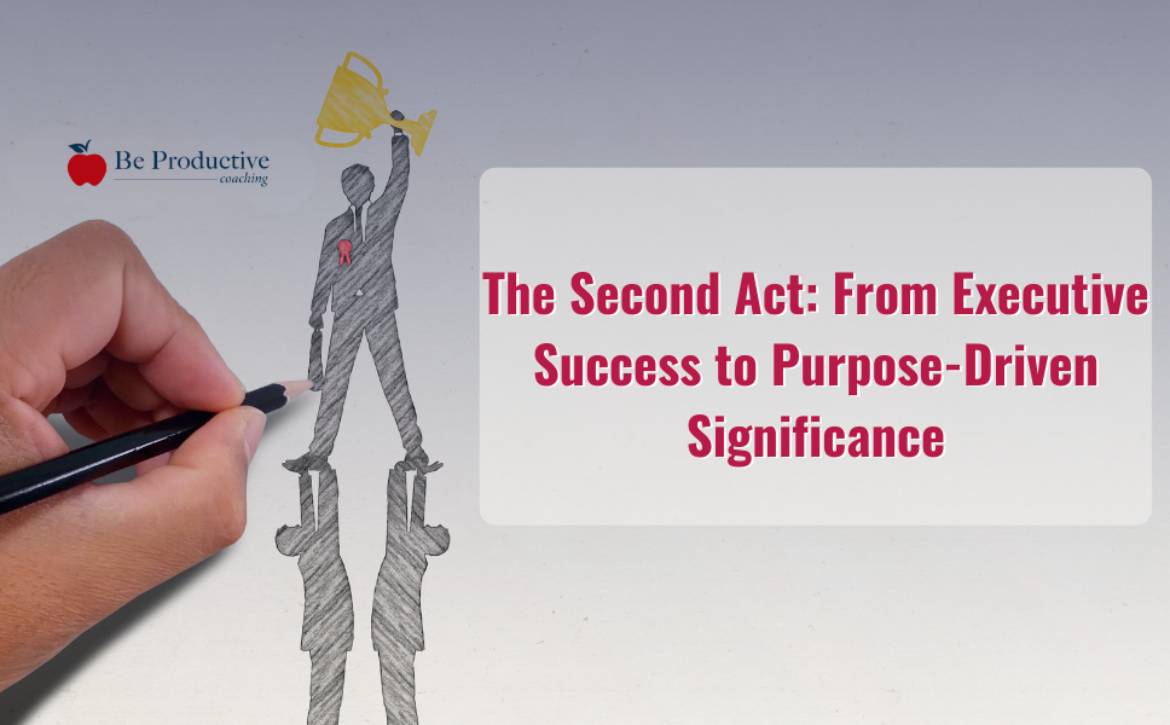
The Second Act: From Executive Success to Purpose-Driven Significance

The Second Act: From Executive Success to Purpose-Driven Significance

The Second Act: From Executive Success to Purpose-Driven Significance

Consider this your tactical reset. We aren’t just scratching the surface anymore; we are dismantling the corporate machine and rebuilding a legacy. If you’re looking for a “retirement plan,” go talk to a financial advisor. But if you’re looking for a Re-Invention, you’re in the right place. This is the manifesto for the executive ready to stop trading time for money and start trading wisdom for impact.

You’ve spent twenty, maybe thirty years, building a monument to your competence. You have the title. You have the “VP” or “C-Suite” etched into the glass. You’ve mastered the art of the quarterly review, the strategic pivot, and the high-stakes negotiation. You’ve earned the “Golden Handcuffs” that comfortable, high-altitude life that everyone else envies.

But there’s a quiet, persistent voice in the back of your mind. It usually shows up at 3:00 AM or during the silent drive home. It asks: Is this it? Is my legacy just a series of spreadsheets and a slightly higher EBITDA?

Welcome to the threshold. This isn’t a midlife crisis. It’s the birth of your Second Act. And as your guide in this transition, I, Vimari Roman, am here to tell you that the skills that got you here are exactly what the world needs there.

The Death of the “Ego-Executive”

To become a purpose-driven leader, something has to die: The version of you that needs to be the smartest person in the room.

In your “First Act,” success was external. It was measured by the size of your budget, the number of direct reports, and the prestige of your firm. You navigated by the stars of ROI and market share. And it worked! It got you here. But those same stars won’t guide you to fulfillment.

The Identity Crisis: Strip the Title

The hardest part of the Second Act isn’t finding a new job; it’s finding a new you. When you strip away the corporate email signature, who are you? At Be Productive Coaching, we see many executives realize they’ve become “human doings” rather than human beings.

This is where my Executive Coaching comes into play. We don’t just talk about your next career move; we talk about your identity. We peel back the layers of corporate conditioning to find the “Founder” or the “Change-Maker” hiding underneath the suit.

The Mental Fitness Frontier (The PQ Factor)

You can’t build a Second Act with First Act mental habits. Most executives are plagued by what we call Saboteurs, the internal voices that generate stress, anxiety, and self-doubt.

As a Certified Positive Intelligence (PQ) Coach, I help leaders identify the “Judge,” the “Hyper-Achiever,” and the “Pleaser” that are currently running their show.

  • The Hyper-Achiever: This Saboteur tells you that you are only as good as your last win. It’s why you can’t enjoy your success.
  • The Pleaser: This one makes you say “yes” to every board seat or consultant gig, even when it drains your soul.

In our PQ Bootcamps, we build the mental muscles needed to quiet these voices. You cannot lead with purpose if you are being led by fear. We move you from Saboteur to Sage, where empathy, curiosity, and innovation become your primary drivers.

 Identifying Your “Zone of Genius”

In the corporate world, we are taught to be “well-rounded.” We work on our weaknesses. We try to be “competent” at everything because that’s what a “good leader” does.

In your Second Act, competence is the enemy. This is a core pillar of my Career Strategy services. If you spend your time doing things you’re merely “good” at, you’re stealing time from the things you were born to do.

The Three Circles of the Be Productive Pivot: 

  1. What the World Needs: Identifying the genuine human ache you want to solve.
  2. What You Are a Master Of: Your high-level executive skills (SOPs, Scaling, Strategy).
  3. What Makes You Feel Alive: The tasks that provide “flow.”

Where these three overlap is your Second Act. If you are a master of operations and you care about environmental equity, your purpose isn’t just “volunteering”; it’s redesigning the supply chain for a green-tech startup.

The “Legacy” Metric and Professional Branding

We’ve spent our lives obsessed with KPIs. In the Second Act, we switch to LPIs: Legacy Performance Indicators.

But here is the catch: to transition from “Corporate Leader” to “Thought Leader,” your brand needs an overhaul. This is why Professional Branding is a cornerstone service at Be Productive Coaching.

Most executive LinkedIn profiles look like a list of chores. A purpose-driven brand looks like a Mission Statement. We work together to rewrite your story not as someone who “managed teams,” but as someone who “engineered cultures of resilience.”

Leading with Radical Empathy

The biggest hurdle for the transitioning executive is moving from Authority to Influence. In the First Act, you had the “stick.” In the Second Act, people follow you because they believe in your “Why.”

The Be Productive Pillars of Purposeful Leadership:

  • Vulnerability as Strategy: Sharing your burnout story (like I do) isn’t weakness; it’s a bridge of trust.
  • Active Listening: Transitioning from “The Solver” to “The Facilitator.”
  • Mentorship as a Mission: Your greatest product isn’t a service; it’s the leaders you leave behind.

In my Leadership Workshops, we practice these “soft” skills because they are the hardest to master. We teach you how to inspire without the threat of a performance review.

Navigating the “Messy Middle”

The transition isn’t a clean jump. It’s a bridge built while you’re walking on it. You will feel like an imposter. This is where my Career Transition Support prevents the “U-Turn” that moment where an executive gets scared and takes another miserable high-paying job just because it’s familiar.

Action Steps for your 2026 Transition:

  1. The Content Audit: Stop reading just the WSJ. Start reading Positive Intelligence and books on social entrepreneurship.
  2. The Network Purge: Find the misfits and the change-makers.
  3. Micro-Purpose Projects: Join a board or start a mentorship program before you quit your day job.

Your Great Work Starts Now

The “First Act” was your training ground. Every late night, every board meeting, every hard-won win was just preparing you for this moment. Don’t let your experience die in a rocking chair. The world needs you to re-engage with a heart that is wide open and a mind that is razor-sharp.

You’ve achieved success. Now, go achieve significance.

Ready to Write Your Second Act?

Pick a time, 7 PM, 8 PM, whatever, and stick to it. Put the phone in a drawer. Close the laptop. The world will not stop spinning if you don’t answer that non-critical email until tomorrow. If the world does stop spinning because you went to dinner, then you have a delegation problem, not a work ethic problem.

The transition from a high-powered executive to a purpose-driven leader isn’t a journey you should take alone. You’ve spent your career hiring the best experts to scale your business; now, it’s time to hire the best expert to scale your impact.

At Be Productive Coaching, we specialize in the “Second Act” for senior professionals. Here is how we can work together:

  • 1-on-1 Executive Coaching & Career Strategy: A deep-dive partnership to identify your Zone of Genius and build your transition roadmap. [Book Your Strategy Call]
  • Mental Fitness (PQ) Bootcamp: Strengthen your mental muscles to silence your Saboteurs and lead from your Sage. [Join the Next Cohort]
  • Keynote Speaking & Team Workshops: Bring the “Be-Great” philosophy to your organization to build resilience and purpose within your teams. [Inquire for Speaking]
  • Professional Branding: Let’s transform your LinkedIn and Resume into a legacy-driven narrative that attracts the right opportunities. [Get Your Brand Audit]

Stop waiting for “someday.” Your Second Act starts with a single decision. Let’s make it together.

The Always-On Burnout Why Your 247 Grind is Actually Your Greatest Liability

The “Always-On” Burnout: Why Your 24/7 Grind is Actually Your Greatest Liability

The “Always-On” Burnout: Why Your 24/7 Grind is Actually Your Greatest Liability

The “Always-On” Burnout: Why Your 24/7 Grind is Actually Your Greatest Liability

Let’s get one thing straight: If your “success” requires you to be tethered to a Slack channel at 10 PM on a Tuesday, you haven’t built a career, you’ve built a cage.

I see it every single day. I talk to brilliant, high-achieving leaders who have everything on paper: the title, the revenue, the influence, but they’re running on fumes and lukewarm espresso. They wear their exhaustion like a designer suit, thinking that “busy” is a synonym for “important.”

Newsflash: It’s not. It’s a slow-motion car crash.

We are living in the era of the “Always-On” Burnout. It’s that vibrating anxiety in your chest when you haven’t checked your phone in twenty minutes. It’s the guilt you feel for taking a lunch break that doesn’t involve a Zoom call. It’s the soul-crushing realization that you’re winning the game, but you’re too tired to enjoy the prize.

It’s time to stop the glorification of the grind. We need to rethink what high-stakes success actually looks like before we all collectively lose our minds.

The Lie We’ve All Bought Into: The “Hustle” Mirage

We’ve been sold this toxic narrative that the only way to stay at the top is to never, ever look away. We think that if we aren’t the first to respond, we’re replaceable. If we aren’t “hustling” while everyone else sleeps, we’re falling behind. We’ve turned “grind” into a personality trait and “rest” into a dirty word.

But here’s the truth that nobody wants to tell you: The “Always-On” model is a low-performance strategy.

When you are constantly reactive, jumping at every notification and treating every email like a five-alarm fire, you are operating from your lizard brain. You’re in survival mode. You are essentially a highly-paid firefighter who never actually puts out the fire, just keeps the smoke from getting too thick. And let me tell you, you cannot lead, innovate, or dominate your market from a place of survival.

True high-stakes success requires vision. It requires the ability to see three steps ahead, to anticipate market shifts, and to manage people with empathy and clarity. You can’t do that when your eyes are glued to a screen 18 hours a day. You’re trading your $10,000-an-hour insights for $10-an-hour busywork.

 Your Brain is Not a MacBook

You can’t just keep 50 tabs open in your brain and expect the system not to crash. Your brain has a finite amount of “decision capital” every day. Every time you check a notification, answer a “quick” question, or switch tasks, you are spending that capital.

When you refuse to “turn off,” your cognitive function plummets. Your decision-making gets sloppy. You start making “good enough” choices instead of “great” ones. Worst of all, your emotional intelligence, the very thing that makes you a great leader, evaporates. You start snapping at your team, missing the nuances in a contract negotiation, and losing the “spark” that got you here in the first place.

The most successful people I know aren’t the busiest. They are the most intentional. They understand that rest isn’t a reward for hard work; it’s a requirement for it. They know that a walk in the woods, a workout without a podcast, or a silent morning isn’t “wasted time,” it’s the R&D department for their next big move. If you don’t give your brain the space to wander, it will never find the solution you’re looking for.

The Psychology of the Ping 

Why are we so addicted to being “on”? It’s dopamine, honey. Every time that little red bubble pops up on your screen, your brain gets a tiny hit of validation. “Someone needs me. I am important. I am productive.”

But there is a massive difference between activity and achievement.

We’ve become addicted to the feeling of being busy because it protects us from the terrifying work of being significant. It’s easy to clear an inbox; it’s hard to sit in silence and figure out why your company’s growth has stalled or how to lead a team through a crisis. We use “Always-On” as a shield against the deep work that actually matters.

3. Mental Resilience (The “Innovate” Power)

In 2026, the shelf-life of a strategy is about six months. If every shift causes you a week of stress, you’re already losing.

Mental Fitness (PQ) allows you to face a market crash, a budget cut, or a technological shift and see it as a Gift and an opportunity. While your competitors are stuck in “Judge” mode, complaining about the change, you are using your innovative power to find the loophole, the new niche, or the smarter way forward.

The Redefinition of High-Stakes Success

What if we stopped measuring success by how many hours we logged and started measuring it by the quality of our presence?

Rethinking success means acknowledging three hard truths:

  • Boundaries are a Power Move: Being unavailable makes you more valuable. If anyone can reach you at any time for any reason, you aren’t a leader; you’re an intern with a better paycheck. Scarcity creates value. When you are protective of your time, people respect it more.
  • Urgency is Often a Performance: Half the things people label as “urgent” are just their own lack of planning or their own anxiety bleeding onto your desk. Stop inheriting other people’s chaos. Just because someone else is panicking doesn’t mean you have to join them.
  • Sustainability is the Only Real Win: If you can’t maintain this pace for the next ten years without a heart attack, a breakdown, or a divorce, your business model is broken. A “successful” life that destroys your health and your relationships is a failure of strategy.

The Cost of the “Yes”

Every time you say “yes” to a non-essential meeting or a late-night call, you are saying “no” to something else. You’re saying “no” to your sleep, “no” to your family, “no” to your health, and “no” to your long-term strategic thinking.

High-stakes success is about the Power of the No. It’s about being ruthless with your time so you can be generous with your impact.

How to Kill the “Always-On” Beast: A Tactical Guide

You don’t need a year-long sabbatical in Bali to fix this (though, hey, if you can do it, go for it). You need a backbone and a strategy. Here is how we start reclaiming your life:

1. The ”Notification Audit”

If it’s not a human being calling you with a genuine emergency, turn the noise off. Your phone should work for you, not the other way around. Most “notifications” are just companies trying to steal your attention so they can sell it to someone else. Take your attention back.

2. The Hard Stop

Pick a time, 7 PM, 8 PM, whatever, and stick to it. Put the phone in a drawer. Close the laptop. The world will not stop spinning if you don’t answer that non-critical email until tomorrow. If the world does stop spinning because you went to dinner, then you have a delegation problem, not a work ethic problem.

3. Reclaim Your Morning

Stop checking your phone the second you wake up. You are literally inviting the world’s demands, the world’s tragedies, and the world’s opinions into your bed before you’ve even had a glass of water. You are starting your day in a defensive crouch. Own your first hour. Meditate, move, read, or just stare at a wall, anything but looking at a screen.

4. Schedule “Deep Work” Blocks

If your calendar is a patchwork of 30-minute meetings, you will never accomplish anything great. You need blocks of at least 90 minutes to 2 hours where you are unreachable. No Slack, no email, no “quick questions.” This is where the magic happens. This is where you actually earn the “high-stakes” title.

5. Stop Performative Responsiveness

We often respond quickly just to show people we are working. Stop it. It sets a dangerous precedent. If you respond to an email at 11 PM, you are telling that person it is okay to email you at 11 PM. You are training people how to treat you. Train them to expect excellence, not instant accessibility.

The Leadership Ripple Effect

When you are an “Always-On” leader, you aren’t just burning yourself out, you’re burning your team out. Your behavior sets the culture. If you are sending emails at midnight, your team feels obligated to read them at midnight.

You are creating a culture of anxiety, not a culture of excellence.

A burned-out team is a stagnant team. They won’t bring you new ideas because they’re too tired to think of them. They won’t take risks because they’re too busy trying to keep up with your frantic pace.

True leadership is about creating a space where people can do their best work. And people do their best work when they feel safe, rested, and trusted. By stepping back and setting boundaries, you give your team permission to do the same. You move from a “command and control” style to a “trust and empower” style.

The Identity Crisis

Let’s talk about the elephant in the room: Who are you if you aren’t “the busy one”?

A lot of the “Always-On” burnout is driven by an identity crisis. We’ve tied our value so closely to our output that the idea of stopping feels like a disappearance. If I’m not working, do I even exist? Am I still successful?

The answer is yes. In fact, you are more successful when you have the agency to stop. Real power isn’t the ability to work 100 hours a week; real power is the ability to choose how you spend your time.

The Science of Stillness

We need to talk about why “doing nothing” is actually a high-performance habit.

There is a concept in physics called “potential energy.” It’s the energy stored in an object because of its position. A bow that is drawn back has potential energy. When you are “Always-On,” you are like a bow that is constantly being fired. You never have the chance to be pulled back, to build up that potential.

Rest is how you build potential energy. It’s how you sharpen the saw.

When you allow yourself to be bored, your brain enters the “Default Mode Network.” This is when your brain starts connecting dots that it couldn’t see when it was focused on a specific task. This is where the “Aha!” moments come from. This is where the billion-dollar ideas are born.

If you are always consuming information, you are never creating it. You need the “white space” to synthesize what you know into something new.

Redefining the Stakes

We call it “high-stakes success” because we think the stakes are the money, the title, or the market share. And sure, those things matter.

But the real stakes? The high stakes?

  • Your health: Chronic stress is a literal killer. No IPO is worth a stroke.
  • Your relationships: Your kids won’t remember your “productivity scores.” They’ll remember if you were there.
  • Your sanity: What’s the point of having the world if you’ve lost the capacity to enjoy it?

Success is only success if you are healthy enough to experience it and have people around you to share it with. Anything else is just a well-funded tragedy.

The Bottom Line: Own Your Life

High-stakes success is about impact, not activity. It’s about being the person who makes the right call, not the person who types the most words.

You were meant for more than just being a highly-efficient processing unit for other people’s requests. You were meant to build, to lead, to innovate, and most importantly, to live.

Stop waiting for permission to slow down. The “Always-On” culture is a choice, and today is the day you opt out. You have to be the one to draw the line in the sand. You have to be the one to say, “My time is valuable, my energy is finite, and my life is more than my job.”

Reclaiming your time isn’t a retreat; it’s a strategic move. It is an investment in your longevity and the quality of your work. The world has enough people who are busy. It needs more people who are effective, centered, and truly awake.

The pressure is high, yes. But the stakes are your life, your health, and your legacy. Don’t waste them on the trivial. Don’t let the “Always-On” burnout rob you of the very success you’ve worked so hard to achieve.

Ready to Stop the Spiral?

If you’re tired of being the most stressed-out person in every room, it’s time to find out what’s actually driving your burnout. It isn’t just your calendar, it’s your internal programming.

Take the Free Saboteur Assessment Here

Discover which mental habits are keeping you “Always-On” and learn how to shift from high-stress survival to high-impact leadership. Let’s build a career that doesn’t require you to set your life on fire to keep the lights on.