
From Nervous to Nailed It: Answer Common Interview Questions with Confidence

From Nervous to Nailed It: Answer Common Interview Questions with Confidence

From Nervous to Nailed It: Answer Common Interview Questions with Confidence

You’ve secured an interview for your dream job, but the face-to-face meeting can be daunting, often turning excitement into anxiety. However, with the proper preparation and mindset, you can transform this experience into an opportunity for genuine confidence. Techniques such as researching the company, practicing self-talk, and visualizing success can help alleviate nerves and enhance your performance, as detailed on USA.gov. Embrace the challenge and remember that feeling anxious is normal and can indicate your enthusiasm for the role.

Understanding Interview Anxiety

Before exploring strategies for overcoming interview anxiety, we must understand what we’re against. Interview nervousness is a common phenomenon that affects job seekers across industries and experience levels. It’s not just about feeling uneasy; for many, it’s a significant hurdle that can severely impact their performance.

Common causes of interview anxiety include:

  • Fear of the unknown
  • Pressure to perform
  • Past negative experiences
  • Imposter syndrome
  • High stakes (especially when it’s a dream job)

These factors can trigger a range of physiological and psychological responses. Your heart rate increases, your palms become sweaty, and you might experience a dry mouth or shaky voice. Cognitively, anxiety can cloud your thinking, making it difficult to recall important information or articulate your thoughts clearly.

The impact on your interview performance can be substantial. Anxiety might cause you to:

  • Ramble or give unfocused answers
  • Forget key accomplishments or skills
  • Appear disinterested or lacking in confidence
  • Misinterpret questions or miss important cues

Understanding these effects is the first step in overcoming them. Feeling nervous is natural – it shows you care about the outcome. The key is learning to channel that energy positively.

Pre-Interview Preparation Strategies

The foundation of a confident interview lies in thorough preparation. This stage is where you begin to transform anxiety into assurance. Let’s break down the critical elements of adequate pre-interview preparation:

Research the Company and Position

Dive deep into the company’s website, recent news, and social media presence. Understanding the company’s mission, values, and recent achievements allows you to align your responses with their culture and goals. For the position, analyze the job description thoroughly. Identify the essential skills and experiences they seek, and prepare examples demonstrating your fit.

Anticipate Common Interview Questions

While you can’t predict every question, many interviews follow similar patterns. Prepare thoughtful responses to classics like:

  • “Tell me about yourself.” (This one is probably the most important as it sets the tone.)
  • “Why do you want to work here?”
  • “What are your greatest strengths and weaknesses?”
  • “Where do you see yourself in five years?”

Master the STAR Method for Behavioral Questions

The STAR method (Situation, Task, Action, Result) is invaluable for structuring responses to behavioral questions. These questions typically start with phrases like “Tell me about a time when…” or “Give an example of…” Practice applying this method to various scenarios from your professional experience.

Conduct Mock Interviews

Enlist a friend, family member, or mentor to conduct practice interviews to help you get comfortable with the interview format and provide feedback on your responses and body language. Consider recording these sessions to self-evaluate your performance.

Prepare Questions for the Interviewer

Thoughtful questions demonstrate your genuine interest in the role and company. They also help you gather vital information to assess if the position is correct for you. Prepare at least 3-5 questions that show you’ve done your homework and are thinking critically about the role.

Mastering Common Interview Questions

Now that we’ve laid the groundwork let’s explore strategies for answering some of the most common interview questions with confidence and clarity.

“Tell me about yourself.”

This open-ended question often serves as an icebreaker but can set the tone for the interview. Your response should be a concise, professional summary, not a personal biography. Structure your answer as follows:

  • Start with your current role and a key accomplishment.
  • Briefly touch on your professional journey and how it led you here.
  • Conclude with why you’re excited about this opportunity.

Example: “I’m a marketing manager at XYZ Corp, where I’ve led campaigns that increased our digital engagement by 40% over the past year. My background in data analytics, which I developed at ABC Inc., has been crucial in driving these results. I’m excited about the opportunity to bring this blend of creative and analytical skills to your team, especially given your focus on data-driven marketing strategies.”

You can refer to this newsletter we wrote on LinkedIn for more details on how to answer this question and subscribe to our newsletter for more. 

“What are your strengths and weaknesses?”

For strengths, choose attributes that align with the job requirements and support them with concrete examples. When discussing weaknesses, show self-awareness and a commitment to improvement.

Strength example: “One of my key strengths is my ability to collaborate across departments. In my current role, I initiated a cross-functional project that streamlined our product development process, reducing time-to-market by 20%.”

Weakness example: “I’ve sometimes struggled with perfectionism, which could lead to unnecessary delays. I’ve addressed this by implementing personal deadlines for each project stage and seeking feedback earlier.”

“Why do you want to work here?”

This question tests your knowledge of the company and your alignment with its values and goals. Your answer should demonstrate that you’ve researched and thoughtfully considered how you can contribute.

Example: “I’m impressed by your company’s commitment to sustainability, particularly your recent initiative to reduce carbon emissions in your supply chain. My experience in green logistics aligns perfectly with this goal, and I’m excited about the opportunity to contribute to such meaningful work.”

“Where do you see yourself in five years?”

Your response should show ambition while aligning with the company’s potential growth trajectory. Be honest but strategic.

Example: “In five years, I aim to deepen my expertise in AI-driven marketing strategies and lead a team implementing these cutting-edge approaches. I’m particularly drawn to your company’s focus on innovation and see it as an ideal environment for professional growth.”

Handling Unexpected or Challenging Questions

Sometimes, interviewers throw curveballs to assess your ability to think on your feet. When faced with an unexpected question:

  • Take a moment to gather your thoughts.
  • If needed, ask for clarification.
  • Structure your response logically, even if you’re unsure.
  • Be honest if you don’t know something, but express eagerness to learn.

Nonverbal Communication and Body Language

While your words carry weight, your nonverbal cues speak volumes. Mastering the art of body language can significantly boost your perceived confidence and rapport with the interviewer.

The Importance of First Impressions

Research shows that interviewers often form initial impressions within the first few seconds of meeting a candidate. Make those seconds count:

  • Arrive early to compose yourself.
  • Enter with a confident posture – shoulders back, head high.
  • Offer a firm handshake and a genuine smile.
  • Make eye contact as you introduce yourself.

Maintaining Eye Contact and Positive Facial Expressions

Throughout the interview:

  • Maintain natural, comfortable eye contact as it conveys confidence and engagement.
  • Smile genuinely when appropriate. It helps create a positive atmosphere.
  • Use facial expressions that match the tone of your words to appear authentic and enthusiastic.

Proper Posture and Hand Gestures

  • Sit up straight, leaning slightly forward to show interest.
  • Keep your hands visible and use natural, controlled gestures to emphasize points.
  • Avoid fidgeting, crossing your arms, or other closed-off postures.

Mirroring and Building Rapport

Subtly mirroring the interviewer’s tone and body language can help establish a subconscious connection. Be careful not to overdo it – the goal is to create harmony, not to mimic.

Building Confidence Through Practice and Mindset

Confidence isn’t just about what you know; it’s about how you feel. Developing a confident mindset is crucial for interview success.

Visualization Techniques

Spend time visualizing a successful interview. Imagine answering questions confidently, building rapport with the interviewer, and leaving with a sense of accomplishment. This mental rehearsal can significantly boost your actual performance. 

Positive Self-Talk and Affirmations

Replace negative thoughts with positive affirmations:

  • Instead of “I’m not qualified enough,” think, “I have unique skills that add value.”
  • Replace “I’ll probably mess up” with “I’m well-prepared and ready to showcase my abilities.”

Power Posing and Confidence-Boosting Exercises

Research suggests that adopting “power poses” (expansive, open postures) before high-stress situations can increase feelings of confidence. Try standing with your hands on your hips, feet apart, for two minutes before your interview.

Reframing Nervousness as Excitement

Anxiety and excitement are physiologically similar. Try reframing your nervousness as positive anticipation. Tell yourself, “I’m excited about this opportunity,” rather than “I’m nervous about this interview.”

Manage Anxiety During the Interview

Being prepared and practicing before the interview should calm your nerves and anxiety but if after reframing your nervousness as positive anticipation you feel anxiety creeping in during the interview then you may want to practice one of these Positive Intelligence reps (PQ reps.) PQ reps are like gym reps for your brain and can effectively keep your focus and calm your nerves. 

Here are a few different exercises you can try. Be sure to do them as you listen.

  1. Take three deep breaths and rub two finger tips together gently but hard enough that you feel all of the ridges of your fingers. Focus on that sensation as you listen.
  2. Take three deep breaths and wiggle your toes and focus on the movement as you listen. Try counting your toes from right to left or left to right. 
  3. Take three deep breaths and gently focus on the interviewer’s facial expressions or pick one feature to stare at while you are listening. The key here is to keep focus, allowing your thoughts to pass by without judgment.

It’s essential to practice these exercises daily to become familiar with them before utilizing them during an interview. This way, you will be better prepared to manage your anxiety and stay focused on the present moment. To learn more about Positive Intelligence and this technique, consider taking our Positive Intelligence Bootcamp. 

Adapting to Different Interview Formats

It helps prepare for various interview formats in today’s job market. Each type requires a slightly different approach:

One-on-One Interviews

  • Focus on building a personal connection with the interviewer.
  • Use their name occasionally and pick up on any personal cues they offer.

Panel Interviews

Make eye contact with each panel member, not just the person asking the question.

Address your answers primarily to the questioner, but engage others with brief eye contact.

Video and Phone Interviews

For video interviews:

  • Ensure your background is professional and well-lit.
  • Look directly into the camera to simulate eye contact.
  • Test your technology beforehand to avoid glitches.

For phone interviews:

  • Stand up and smile – it affects the tone of your voice positively.
  • Keep your resume and notes handy for easy reference.

Assessment Centers and Group Interviews

  • Show leadership without dominating.
  • Demonstrate teamwork by actively listening and building on others’ ideas.
  • Stay focused on the task at hand while showcasing your interpersonal skills.

Post-Interview Success Strategies

Your performance doesn’t end when you leave the interview room. Follow-up actions can reinforce a positive impression:

Effective Follow-Up Techniques

  • Send a thank-you email within 24 hours of the interview.
  • Reiterate your interest in the position and briefly remind them of your key qualifications.
  • If you discussed sending them any additional information or documents, provide them promptly.

Thank You Notes and Emails

  • Personalize your message by referencing specific points from the interview.
  • Keep it concise, professional, and error-free.
  • Use this opportunity to address any points you could have expanded on during the interview.

Handling Job Offers and Negotiations

If you receive an offer:

  • Express enthusiasm and gratitude.
  • Ask for time to consider the offer if needed.
  • If negotiating, be honest and confident about what your “must haves” are and focus on the value you bring to the company rather than personal needs. Be ready to meet in the middle. 

Learning from Rejections

If you don’t get the job:

  • Ask for feedback on your interview performance.
  • Reflect on what you could improve for next time.
  • Keep the door open for future opportunities by maintaining a professional attitude.

Elevate Your Career: Interview Coaching at Be Productive

The journey from nervous interviewee to confident candidate involves preparation, practice, and mindset. By researching the company, anticipating common questions, mastering nonverbal communication, and using confidence-boosting techniques, you can transform your interview experience. Each interview is an opportunity for personal growth and professional development. Applying these strategies will turn your nervousness into genuine confidence, allowing you to showcase your valuable skills and experiences.

At Be Productive Coaching, we understand the challenges professionals face when preparing for job interviews, and we’re here to help you unlock your full potential. Our personalized coaching sessions transform your interview skills, equipping you with the confidence and strategies you need to excel. Whether you aim to land your dream job or advance your career, we’ll refine your communication and highlight your strengths. 

Ready to take the next step? Book a free consultation with us today and start your journey to success!


How to Find a Job After a Layoff: Turn Setbacks into Success

How to Find a Job After a Layoff: Turn Setbacks into Success

How to Find a Job After a Layoff: Turn Setbacks into Success

In today’s dynamic job market, finding a job after a layoff can be daunting. However, what may seem like a setback can become a stepping stone to new opportunities and professional growth. This comprehensive guide will walk you through rebounding from a layoff and finding your next great job opportunity.

Understanding the Emotional Impact of Job Loss

Experiencing a layoff can trigger a rollercoaster of emotions. It’s crucial to acknowledge and process these feelings as you begin your journey back to employment. Remember, it’s okay to feel this way.

  • Shock and Disbelief: The initial reaction to a layoff is often disbelief. You might ask, “Why me?” or “How did this happen?”
  • Anger and Frustration: As reality sets in, anger towards your former employer or the situation may surface.
  • Anxiety and Fear: Concerns about financial stability and future job prospects can lead to heightened anxiety.
  • Loss of Identity: For many, a job is more than just a paycheck; it’s a part of who they are. Losing that can lead to a sense of lost identity.
  • Depression: The combination of these emotions can sometimes lead to feelings of hopelessness or depression.

It’s important to remember that these reactions are normal and part of the grieving process for job loss. Acknowledging these emotions is the first step in moving forward. Consider seeking support from friends, family, or a professional counselor to help navigate this challenging time. You don’t have to go through this alone.

Immediate Steps After a Layoff

Once you’ve begun to process the initial shock, it’s time to take action. Here are some crucial steps to take immediately after a layoff:

Review Your Severance Package: Carefully examine any severance offer from your former employer, including:

  • Continuation of salary for a specified period
  • Extension of health benefits
  • Outplacement services
  • Payout of accrued vacation time

File for Unemployment Benefits: Be sure to apply for unemployment compensation. These benefits provide a financial cushion while you search for new opportunities. 

Assess Your Financial Situation: Create a budget that reflects your new financial reality. Consider:

  • Cutting non-essential expenses
  • Negotiating bills with creditors
  • Exploring options for health insurance coverage

Secure References: Contact former colleagues and supervisors for references while your contributions are still fresh in their minds.

Branding: Updating your LinkedIn profile is crucial, as it’s often the first place potential employers will look. Make sure it accurately reflects your most recent experience and skills.

Notify Your Professional Network: Let your contacts know you’re open to new opportunities. Many jobs are filled through personal connections and referrals.

These steps can help you maintain financial stability and position yourself for a successful job search.

Crafting Your Job Search Strategy

After addressing the immediate concerns, it’s time to develop a comprehensive job search strategy. This plan will serve as your roadmap to re-employment.

Reassess Your Career Goals

A layoff can be an opportunity to reassess your career trajectory. Ask yourself:

  • Are you satisfied with your current career path?
  • Do you want to explore new industries or roles?
  • What skills have you developed that could be valuable in different contexts?

This reflection can help you target your job search more effectively and potentially open doors to exciting new opportunities.

Brand Yourself: Update Your Resume and Cover Letter

Your resume and cover letter are your primary marketing tools in the job search process. Here’s how to make them stand out:

  • Tailor your resume for the next step: Highlight skills, experiences, and the accomplishments most relevant to the job you’re applying for.
  • Use action verbs and quantifiable achievements: Instead of listing job duties, focus on your accomplishments and back them up with data where possible.
  • Address the layoff proactively: If asked, be honest about the layoff but focus on what you learned and how you’ve grown from the experience.
  • Craft compelling cover letters: Use your cover letter to tell your unique story and explain why you’re the ideal candidate for the position.

Expand Your Skill Set

Use this time between jobs to enhance your marketability:

  • Take online courses: Platforms like Coursera, edX, and LinkedIn Learning offer many courses to boost your skills.
  • Earn certifications: Industry-recognized certifications can set you apart from other candidates.
  • Attend workshops and webinars: These can provide valuable knowledge and networking opportunities.

Leverage Your Network

Networking remains one of the most effective ways to find new job opportunities:

  • Reconnect with former colleagues: They may know of openings in their current companies.
  • Attend industry events: Both virtual and in-person events can lead to valuable connections.
  • Join professional associations: These groups often have job boards and networking opportunities for members.
  • Utilize social media: Engage in industry-related discussions on LinkedIn and Twitter to increase your visibility.

Navigating the Job Application Process

As you begin applying for jobs, it’s essential to approach the process strategically and persistently.

Job Search Techniques

Diversify your job search methods to maximize your chances of success:

  • Online job boards: Sites like Indeed, LinkedIn, and industry-specific job boards can be valuable resources.
  • Company websites: Many companies post job openings directly before advertising elsewhere.
  • Use the 80/20 rule: When reading job descriptions, do not hold back! Use the 80/20 rule. What does this mean? This means that you can do 80% of what they are asking for in the job description, and you can learn the other 20%. Remember that the job description is written for the perfect candidate to discourage candidates who will not be the best fit. Be confident in your 80%!
  • Recruitment agencies: Staffing firms can connect you with opportunities that match your skills and experience.
  • Informational interviews: Conversations with other industry professionals can provide insights into companies and industries, potentially leading to job opportunities.

Preparing for Interviews

Once you start landing interviews, thorough preparation is critical:

  • Research the company: Understand the company’s mission, values, and recent news.
  • Be ready to tell them about yourself: The “tell me about yourself” question is 99% of the time the first question asked during an interview. How you answer it will set the tone for the rest of the interview. Focus on your professional background (including education if you are a young professional), what you have to offer, and why you are there. Be brief. This answer should be one to two minutes max and must be at a high level. Let them ask follow-up questions for details.
  • Practice other common interview questions: Be ready to discuss your experience, skills, and how you’ve handled challenges in more detail. Situational questions are so common, so be ready. 
  • Prepare questions for the interviewer: This demonstrates your interest and engagement. Always have at least three questions ready. 
  • Address the layoff: If asked about your layoff, have a concise, positive explanation ready. Be honest and show confidence. 
  • Follow up after the interview: Send a thank-you note or email reiterating your interest and qualifications. Remember to include everyone in the hiring process.

Maintaining Resilience During the Job Search

Job searching can be a lengthy process, and it’s crucial to maintain your motivation and well-being throughout.

Establish a Routine

Treat your job search like a job itself:

  • Set regular working hours for job search activities
  • Create a dedicated workspace
  • Set daily and weekly goals for applications, networking, and skill development

Practice Self-Care

Taking care of your physical and mental health is crucial during this time:

  • Maintain a regular sleep schedule
  • Exercise regularly
  • Practice stress-reduction techniques like meditation and exercise
  • Stay connected with supportive friends and family

Stay Positive and Persistent

Rejection is a normal part of the job search process. Remember:

  • Each application and interview is a learning opportunity
  • Celebrate small wins along the way
  • Keep refining your approach based on feedback and results

Embracing Your New Role

Once you secure a new position, approach it with enthusiasm and a growth mindset:

  • Set clear goals: Establish your goals in your first 30, 60, and 90 days.
  • Build relationships: Connect with your new colleagues and seek out mentorship opportunities.
  • Continue learning: Stay curious and look for ways to expand your skills and knowledge in your new role.

How Can Be Productive Coaching Help You?

Navigating a job search after a layoff can be challenging, but you don’t have to do it alone. At Be Productive Coaching, we specialize in helping professionals like you turn career setbacks into opportunities for growth and success. We provide personalized guidance to help you craft a winning job search strategy, build confidence, and land your next significant role. 

Ready to turn your layoff into an opportunity? Schedule a free consultation with Be Productive Coaching today to start your journey to success.

FAQs

What are the best steps to take after a layoff?

A: After a layoff, carefully process your emotions and review your severance package. File for unemployment benefits, update your branding (resume and LinkedIn profile), and notify your network about your job search. Assess your finances and consider taking courses to enhance your skills. These steps will help you regain stability and position yourself for new opportunities.

How long does it typically take to find a job after being laid off?

A: The time to find a job after a layoff varies, typically 3 to 6 months, depending on factors like industry demand, networking efforts, and flexibility. Specialized skills and a strong network can shorten this period. While it may take time, persistence and a strategic approach will help you secure a new role.

How do you stay motivated during a job search after a layoff?

A: Staying motivated during a job search involves establishing a routine, setting achievable goals, and practicing self-care. Maintain a positive mindset by staying connected with supportive people and continuing to learn new skills. Celebrate small wins and remember that persistence is critical to finding the right job.

Level Up Your Resume: Crafting a Job-Winning Profile

Level Up Your Resume: Crafting a Job-Winning Profile

Level Up Your Resume: Crafting a Job-Winning Profile

In today’s fiercely competitive job market, your resume serves as your professional portrait – a snapshot of your career that can make or break your chances of landing that dream job. But how do you transform your resume from a mere list of experiences into a compelling narrative that captures the attention of employers and recruiters alike? According to the U.S. Department of Labor, a well-crafted resume is essential for job seekers, and there are specific strategies you can use to make yours stand out. By tailoring your resume to the specific job you’re applying for, highlighting your achievements and skills, and using clear and concise language, you can increase your chances of getting noticed by potential employers. 

Understanding Modern Resume Trends

The landscape of resume writing has evolved significantly in recent years. Today’s employers and recruiters expect more than just a chronological list of your past positions. They’re looking for a strategic document that clearly communicates your value proposition and aligns with their specific needs.

One of the most significant shifts in resume trends is the growing importance of Applicant Tracking Systems (ATS). These software tools, used by many companies to streamline their hiring process, scan resumes for relevant keywords and qualifications before they ever reach human eyes. This means your resume needs to strike a delicate balance:

  • It must be optimized for ATS to ensure it passes the initial screening.
  • It should remain engaging and readable when it reaches human reviewers.

To achieve this balance, focus on incorporating industry-specific keywords naturally throughout your resume while maintaining a clear, concise narrative of your professional journey.

Structuring Your Resume for Maximum Impact

The foundation of a job-winning profile lies in its structure. Depending on your career level, industry, and specific circumstances, you’ll want to choose the resume format that best showcases your strengths:

  • Chronological: Ideal for those with a steady career progression in one field.
  • Functional: Beneficial for career changers or those with employment gaps.
  • Combination: A hybrid approach that highlights both skills and experience.

Regardless of the format you choose, certain sections are essential in any modern resume:

  • Contact Information
  • Professional Summary 
  • Work Experience with Top Achievements
  • Education
  • Skills

For senior professionals or those in specialized fields, consider adding sections for publications, speaking engagements, or technical proficiencies.

Crafting a Compelling Professional Summary

Your professional summary is your elevator pitch – a concise yet powerful introduction that sets the tone for the rest of your resume. This 3-4 sentence paragraph should encapsulate your professional identity, key strengths, and soft skills.

When writing your summary, consider these key elements:

  • Your professional title or area of expertise.
  • Years of relevant experience.
  • Top 2-3 skills or qualifications that set you apart.
  • A notable achievement or unique value proposition.

Here’s an example of an effective professional summary:

“Results-driven Marketing Manager with 8+ years of experience in digital marketing and brand development. Expert in database management and segmentation techniques. Proven track record of increasing online engagement by 200% and driving $2M in additional revenue through innovative campaign strategies. Highly organized and efficient independent worker who thrives in a high-pressure and time-sensitive environment. Collaborates and communicates with cross-functional teams to bring compelling integrated marketing campaigns that increase brand awareness, nurture target audience, and boost sales.”

Showcasing Your Skills and Achievements

The heart of your resume lies in how you present your skills and achievements. It’s not enough to simply list your responsibilities – you need to demonstrate the impact you’ve made in your previous roles.

Start by categorizing your skills:

  • Hard skills: Technical abilities specific to your field
  • Soft skills: Interpersonal and transferable skills
  • Technical skills: Proficiency with relevant tools and technologies

When describing your achievements, use the PAR (Problem-Action-Result) method to create compelling bullet points:

  • Problem: Identify a challenge you faced
  • Action: Describe briefly the steps you took to address it
  • Result: Quantify the outcome, using metrics wherever possible

For example:

“Streamlined inventory management process, reducing stockouts by 30% and increasing overall efficiency by 25%.”

Remember to use strong action verbs to begin each bullet point, such as “spearheaded,” “implemented,” or “optimized.” These power words add dynamism to your resume and help paint a picture of your proactive approach to work.

Optimizing Your Resume for ATS and Human Readers

To ensure your resume makes it past ATS and impresses human reviewers, consider these optimization strategies:

  • Incorporate relevant keywords from the job description naturally throughout your resume.
  • Use standard section headings that ATS can easily recognize (e.g., “Work Experience” instead of “Professional Journey”).
  • Stick to common fonts like Arial or Calibri, and use a font size between 10 and 12 points.
  • Avoid using tables, graphics, or complex formatting that may confuse ATS.
  • Save your resume in a widely compatible format like .docx or .pdf.

While optimizing for ATS, don’t forget the human element. Use white space effectively, employ bullet points for readability, and ensure your resume tells a coherent story of your professional growth.

Tailoring Your Resume for Specific Opportunities

One size does not fit all when it comes to resumes. To maximize your chances of success, tailor your resume towards the next step, the position you want to apply to:

  • Research the company culture and values.
  • Analyze the job description for key requirements and preferred qualifications.
  • If your resume does not already align your experience and skills with the specific needs of the role then make sure you revise it. 
  • Use industry-specific language and acronyms where appropriate.
  • Make sure that you write a customized cover letter that aligns with the position and the company, and highlight one or two bullets that address the most important qualifications they are seeking. 

For career changers or those with non-traditional backgrounds, focus on highlighting transferable skills and relevant projects or volunteer work that demonstrate your capabilities in the new field.

Enhancing Your Resume with Additional Elements

To give your resume extra punch, consider incorporating these elements:

  • Relevant certifications and training
  • Volunteer work or community involvement
  • Language skills and international experience
  • Publications, presentations, or notable projects
  • Include a Cover Letter

These additional elements can set you apart from other candidates and provide talking points for interviews.

Proofreading and Refining Your Resume

Before sending out your resume, take the time to thoroughly proofread and refine it:

  • Use online tools like Grammarly for initial checks.
  • Read your resume aloud to catch awkward phrasing.
  • Ask a trusted colleague or mentor to review it.
  • Double-check that all information is accurate and up-to-date.

Common mistakes to avoid include inconsistent formatting, typos, and outdated contact information.

Complementing Your Resume with a Strong Online Presence

In today’s digital age, your resume is just one part of your professional profile. Enhance your job search by:

  • Aligning your LinkedIn profile with your resume
  • Creating a personal website or online portfolio if appropriate 
  • Managing your digital footprint across social media platforms (nothing is private these days!)

A cohesive online presence reinforces your professional brand and provides additional avenues for employers to learn about your skills and experiences.

Transform Your Resume, Transform Your Career

Crafting a job-winning profile is both an art and a science. By understanding current resume trends, structuring your document effectively, showcasing your achievements, and tailoring your approach to each opportunity, you can create a resume that not only passes ATS screening but also captivates human readers. Remember, your resume is a living document – continue to update and refine it as you grow in your career.

At Be Productive Coaching, we specialize in helping professionals like you elevate their careers through expert resume writing and career coaching services. Ready to take your resume to the next level? Contact Be Productive Coaching and schedule your free consultation for personalized guidance and expert support in crafting your job-winning profile.

Why Do People Hate Their Jobs So Much?!

Why Do People Hate Their Jobs So Much?!

Why Do People Hate Their Jobs So Much?!

In the frenetic world of corporate America, a startling number of individuals find themselves trapped in the grip of job dissatisfaction. The once-promising career path has transformed into a grueling nine-to-five drudgery, leaving many to ponder: Why do people hate their jobs so much? This pervasive sense of workplace unhappiness has become a critical issue, affecting not only individual well-being but also organizational productivity and economic growth. According to a recent report by the U.S. Bureau of Labor Statistics, job dissatisfaction costs American businesses over $550 billion annually in lost productivity and employee turnover. 

Common Causes of Job Hatred

The reasons behind job dissatisfaction are as diverse as the workforce itself. However, several key factors consistently contribute to the pervasive sense of professional misery:

Lack of Purpose and Meaning

Many employees experience a profound disconnect between their daily tasks and any sense of higher purpose. This professional purpose deficit can lead to a feeling of emptiness and futility in one’s work.

Poor Work-Life Balance

The constant struggle to juggle professional responsibilities with personal life often results in burnout and resentment towards one’s job. This imbalance can significantly impact mental health and overall life satisfaction.

Toxic Workplace Culture

A negative work environment, characterized by office politics, lack of support, and poor communication, can quickly turn a dream job into a nightmare. Workplace negativity spirals can be particularly damaging to employee morale

Insufficient Compensation and Benefits

Feeling undervalued and underpaid for one’s efforts is a major source of job dissatisfaction. When employees perceive a mismatch between their contributions and rewards, it can lead to decreased motivation and engagement.

Limited Growth Opportunities

Career stagnation and a lack of professional development prospects can leave employees feeling trapped and unfulfilled. The absence of a clear career path often results in a loss of occupational motivation.

Misalignment with Personal Values

When an individual’s values clash with those of their employer or industry, it can create a sense of moral discomfort and professional disenchantment.

The Psychology Behind Job Dissatisfaction

To truly understand the phenomenon of job hatred, we must examine the psychological factors at play:

Maslow’s Hierarchy of Needs in the Workplace

Abraham Maslow’s famous theory can be applied to the work environment. When basic needs such as job security and fair compensation are not met, employees struggle to reach higher levels of satisfaction and self-actualization in their roles.

The Impact of Unfulfilled Expectations

Many enter the workforce with high hopes and expectations. When reality fails to meet these ideals, it can lead to profound disappointment and disillusionment.

The Role of Intrinsic and Extrinsic Motivation

While extrinsic motivators like salary and benefits are important, intrinsic factors such as personal growth and meaningful work often play a more significant role in long-term job satisfaction.

Cognitive Dissonance in Career Choices

The mental discomfort experienced when one’s beliefs about one’s ideal career clash with the reality of one’s current job can contribute to ongoing dissatisfaction and stress.

The Consequences of Hating Your Job

Job dissatisfaction syndrome is not just a personal problem; it can have far-reaching consequences:

Mental Health Issues

Prolonged exposure to a disliked job can lead to stress, anxiety, and depression. Work-related depression is a growing concern in many industries.

Physical Health Problems

The mental toll of job dissatisfaction often manifests in physical symptoms, including headaches, fatigue, and a weakened immune system.

Decreased Productivity and Performance

Unhappy employees are typically less productive, which can impact both individual career prospects and overall company performance.

Negative Impact on Personal Relationships

The strain of job-related emotional exhaustion often spills over into personal life, affecting relationships with family and friends.

Career Stagnation and Missed Opportunities

Those stuck in jobs they hate may miss out on valuable opportunities for growth and advancement, further exacerbating their dissatisfaction.

Strategies for Improving Job Satisfaction

For those experiencing workplace unhappiness, there are several strategies to consider:

Self-Assessment and Goal-Setting

  • Take time to reflect on your values, strengths, and long-term career aspirations.
  • Set clear, achievable goals that align with your personal and professional objectives.

Developing New Skills and Competencies

  • Invest in continuous learning to enhance your value and open up new opportunities.
  • Seek out training programs or certifications that can broaden your skill set.

Improving Communication with Supervisors and Colleagues

  • Foster open dialogue with your superiors about your role and expectations.
  • Build positive relationships with coworkers to create a more supportive work environment.

Seeking Opportunities for Growth Within the Current Role

  • Look for ways to take on new responsibilities or lead projects that interest you.
  • Propose innovative ideas that can benefit both you and your organization.

Cultivating a Positive Mindset and Practicing Gratitude

  • Focus on the aspects of your job that you do enjoy, no matter how small.
  • Regularly acknowledge the positive elements of your work life to maintain perspective.

When to Consider a Career Change

Sometimes, despite best efforts, a job may simply be the wrong fit. Here are signs it might be time to move on:

  • Persistent feelings of dread or anxiety about work.
  • Lack of engagement or interest in your tasks.
  • Misalignment between your values and the company’s culture.
  • Limited growth potential within the organization.

Steps to prepare for a career transition include:

  • Conducting thorough research on potential new fields or roles.
  • Networking with professionals in your desired industry.
  • Updating your skills and qualifications as needed.
  • Creating a financial buffer to support your transition.

Overcoming fears and obstacles in career changes requires courage and careful planning. Remember that many successful professionals have navigated career shifts and emerged more satisfied and fulfilled.

Transform Your Career with Be Productive Coaching

Job dissatisfaction is a complex issue with no one-size-fits-all solution. However, by understanding its causes and actively working to improve our work lives, we can move towards greater fulfillment in our careers. Whether it’s through personal growth, workplace improvements, or bold career changes, there are always paths to a more satisfying professional life.

Remember, you’re not alone in facing these challenges. Many have successfully navigated the journey from job hatred to career contentment. If you’re struggling with job dissatisfaction, Be Productive Coaching can help you navigate your career challenges and find fulfillment in your professional life. By working with us, you can gain clarity on your career goals, develop strategies to overcome obstacles and build confidence to take control of your career. With the right guidance and support, you can transform your job from a source of stress and unhappiness to a source of joy and fulfillment. Don’t settle for a life of workplace misery – take the first step towards a more rewarding career by booking a free consultation with Be Productive Coaching today.

Copy of Copy of Copy of Top talent

It’s Halftime: Steps to Navigating Your Transition

“I had a successful career yet I knew there was something even more significant I wanted to do with my life.”


This was me when I hit the “halftime” in my career and personally. I had achieved success, titles, corner offices, bonuses, and the six-figure salary in a 22-year career but I knew there was much more to life. I also knew that I didn’t have the right partner to spend the next half with. 🤯

I knew that I needed to serve at a higher level. NO that didn’t mean a higher title or salary. It meant that I needed to utilize my God-given talents to serve others and truly leave a legacy.

I knew I wanted to feel honored and loved. I wanted a life partner that I trusted and enjoyed being with, and that supported my need for service.

My halftime took place in 2013. Within a few months, I separated from my last corporate job, got divorced, and started my own business.

That transition took guts and it took strong mental muscles. It took me believing in myself and what God had planned for me. 💪🏼🙏🏼🧠
Today, I feel blessed to have had that halftime awakening because I now get to use my talents to do work that fulfills me while serving others. I get to share my life with a partner that I enjoy spending time with. A partner that loves and honors me. I’ve done more in the last eight (8) years than I did in 22 and the good news is that YOU CAN TOO!

Whether it be in your career or personal life, you’re in “halftime” when you face a transition that leaves you asking “what’s next?” Halftime is not determined by age but rather by stage.

You are in the halftime stage if you…

đź’Ą You leave work each night feeling stressed, deflated, sad, and uninspired.
đź’Ą You are no longer excited or challenged in your position or workplace.
đź’Ą Your relationships and physical health are suffering from the anxiety you feel.
đź’Ą You want to feel confident again.
đź’Ą You want to feel excited and fulfilled doing work that will make a difference.
đź’Ą You want to feel closer than ever before to God, your spouse, and your family.
đź’Ą You want greater clarity to redefine your goals, passions, and purpose.

If this sounds like you then this means that you are ready to venture and journey towards your life’s purpose. You are ready for greater significance!

Now you are probably wondering, okay, so what’s next? How do I move forward with this transition?

I am not going to lie, transitions take time but the good news is that you are not alone and there are many steps you can take to help you navigate this halftime. The first thing is to take action – Action Always Beats Intention!

đź’Ą Align yourself with other leaders making a difference in your areas of interest.

đź’Ą Keep moving forward – have faith that you will soon discover your next steps and take one action each day that will help you get closer.

đź’Ą Go back to your younger self and ask “what did you want to be when you grew up?” Listen to your younger self and write down what he/she tells you.

đź’Ą Go inward: think about what moves you, what brings you joy, and what you would want more of in your life. Then do start doing more of that.

đź’Ą Strengthen your mental muscles. Transitions take strong mental muscles, motivation, and peak performance. You’ll need to be dramatically calm and clear to create lasting change. The best leaders, athletes, and entrepreneurs have strong mental muscles. Yet 80% of people score below the minimum level of mental fitness required for peak performance and happiness. You’ll need to implement mental fitness to build strong mental muscles to help you navigate your saboteurs when they attack you. Take your free saboteur assessment so that you can recognize your saboteurs and be ready when they get ready to hijack you: https://assessment.positiveintelligence.com/saboteur/overview

đź’Ą Get someone in your corner that can help you. This could be a friend, an ex-colleague, a mentor, or a coach. If you hire a coach make sure it’s someone who works in this area of expertise and has some references.
If you find yourself in “Halftime” then I want to congratulate you. Take these steps and you’ll find that your second half can be even better than your first.

If you want someone who’s in your corner to help you navigate this transition, I can help. đź‘‹ Schedule a free coaching session: www.beproductivecoaching.com/contact

change jobs during covid-19 (1)

This is a perfect time to change jobs – Yes, even during COVID-19

There is no perfect time like the present. Yes, even during COVID-19.

The truth is that if you wait for a perfect time to change jobs you may wait a long time. The right time to change a job is the minute that you start thinking of doing so. The present time is always the best time. Chances are you have good reasons to want to make this transition and I am here to tell you that you shouldn’t wait.

I am well aware that more than 50 million Americans have filed for unemployment since the start of the pandemic and this is definitely something to be concerned about. However, the most recent US Department of Labor release shows that the weekly unemployment claims dropped below one million for the first time since March according to a Wall Street Journal article from Aug 13, 2020, and although the numbers are still high this should not hold you back from looking for your next opportunity.

Here is why this is the right time for you to start looking.

  • Number one – Companies are still hiring!
  • People are moving – many people have taken this time to re-evaluate their situations and have decided to relocate which means that jobs locally are starting to open up.
  • Lack of happiness – people were not happy with their jobs before the pandemic and are still planning on changing jobs.
  • Better opportunities – as humans our need for growth is still there and many are still searching for more money, more responsibility, better benefits, etc.
  • Fulfillment – this pandemic has put things into perspective for many. More and more people are looking to change jobs that are no longer exciting for them. They have either outgrown their careers or they were in a career that they didn’t like and have taken this time to align themselves and their future.

As daunting as it may be to look for a new job during a global crisis, there are still opportunities to be found. Here are some reasons to consider changing jobs amid COVID-19.

  • Excitement and Joy – do you wake up excited and ready for the day or do you wake up dreading your work? This is a huge indication that you may be ready for a change.
  • Uninspired – do you leave work every night worn-out, deflated, and uninspired? Life is too short to hate your job.
  • Purpose and Alignment – the pandemic gives you an invitation to reflect and align your career with your values and lifestyle. If you are like many of us, you’ve taken some of the downtimes to really evaluate where you are and where you want to go. For many, this includes their careers. Ask yourself if your current job aligns with your strengths and your purpose and if it doesn’t then that’s an indication that you are ready to move forward.

If you are lacking excitement, joy, purpose, and alignment and feel uninspired then the time is now. Here are some ways that you can prepare for your job search:

  • Take an online class that may help you build on your transferrable skills.
  • Get clear – really think about what you want to do next. Think about the lifestyle you want to have (work from home, travel, flexibility, etc). Think about what fulfills you. What is your expertise? What sets you apart from your competitors?
  • Career Strategy – once you get clear, its time to create a career strategy. Identify companies of interest, job titles, and read job descriptions. Use the 80/20 rule – if you can do 80% of the work and it excites you then that’s a good fit.
  • Network – The smartest way to transition is to connect with people in the field and organizations of interest. We are all craving connection so this is the best time to reconnect with old friends, friends of friends, old colleagues, and members of college alumni networks.
  • LinkedIn – is the world’s largest professional network with 706+ million users in more than 200 countries and territories worldwide. 95% of recruiters use LinkedIn to find top-notch candidates.  Make sure that your profile is strategically updated and that your professional brand makes you stand out from the crowd.
  • Resume – make sure your resume is updated and ATS friendly. Focus on your major accomplishments and make sure that the resume strategy is clear.
  • Interview Preparation – most interviews are taking place over the phone and via video. Practice and make sure that your space at home if you are working from home is set up for good video and connectivity.

It’s time to get you out of paralysis analysis and into a thriving career. Do work that brings you excitement and fulfillment. Life is too short to hate your job. You will be happier, and your family, friends, and coworkers will be happier to be around you.

Do you have a personal experience with transitioning during the coronavirus you’d like to share? Please email info@beproductivecoaching.com and tell us your story.

Not sure where to start? Book a complimentary 30-minute discovery consultation. SCHEDULE A CONSULTATION

Copy of Blue Grayscale Photo Job Vacancy Announcement (2)

10 Tips to Stop Hating Interviews

Most people dread interviews. Wait, let me rephrase that…most people hate interviews. I have heard so many people say that they wish that interviews were not a part of the process. But how else would a potential employer know if you are a good fit? I can certainly understand why you would dread or hate interviewing. Not only are you going in to speak with a stranger about your work experience, but in most cases, you are hoping that they will hire you. Many times the fear of rejection sets in from when you are asked to come in for the interview or jump on that phone or Zoom call.

I like to compare interviewing with dating. Most of us feel a sense of excitement and, at the same time, a sense of anxiety and fear when we are first asked to go on a date. You are excited that you are getting the opportunity to go on a date with someone who interests you and happy that the person has shown interest in you as well. Still, you have no idea what to expect. You start planning what you are going to wear, you may practice your greeting, and these days you may even look them up on Facebook or Google them. You prepare for the date so that you feel more at ease and so that perhaps you can have the opportunity for a second date.

Well, interviewing for a potential job is no different. Just like you prepare or prepared (if you are no longer dating) for that special date, you should also prepare for the interview with your potential employer.

Following are a few tips to help you prepare and stop hating interviews:

  • Research the company by getting to know their mission, vision, and any latest news. Check to see if you know anyone who works there and perhaps give them a call to find out what they like about the company.
  • Get the name of the person you will be meeting with and look them up on LinkedIn and Google.
  • Put a list of at least ten questions that you will ask during the interview.
  • Practice! Grab a friend or colleague and ask them to mock interview you. Put together a list of questions and practice, practice, practice.
  • Make networking a part of your practice. Reduce your fear of meeting and talking to a stranger by getting out to network. If you cannot network in person, then network on LinkedIn and ask them to join you for coffee or a Zoom call. Speaking to strangers and asking questions to get to know them will improve your conversational skills and reduce the fear that creeps up during interviews.
  • Visualize your interview. Work through the questions in your mind and begin to answer questions that may come up. I always recommend practicing the “tell me about yourself questions.”
  • Write down what has made you nervous in interviews in the past. Then work through those points to overcome them.
  • Make a list of your accomplishments. Everything you are proud of, read it out loud, then read it to a friend and then practice saying it to your friend without the list.
  • Find out what the dress code is and take it up a notch and wear something that makes you feel good. Make sure you pull out your outfit and try it on a few days before to make sure it fits well and looks professional.
  • Work out! Yes, before going to your interview, do something to move your body. Preferably cardio. Try to take the day off if you can or go in late to work so that you have time to exercise. Get your sweat on and release those endorphins. These endorphins trigger positive feelings and will get you in the right state of mind before the interview.

These tips should help ease the nervousness and anxiety that comes from interviewing. Also, do not forget that you are interviewing them as much as they are interviewing you. Make sure you ask all the questions you need to determine if this is a good fit for you as well. 


Need help with interview preparation? A small investment can go a long way in your preparation and help you set yourself apart. Set up a free consultation to learn more about our packages: www.beproductivecoaching.com/contact

LinkedIn Training (1)

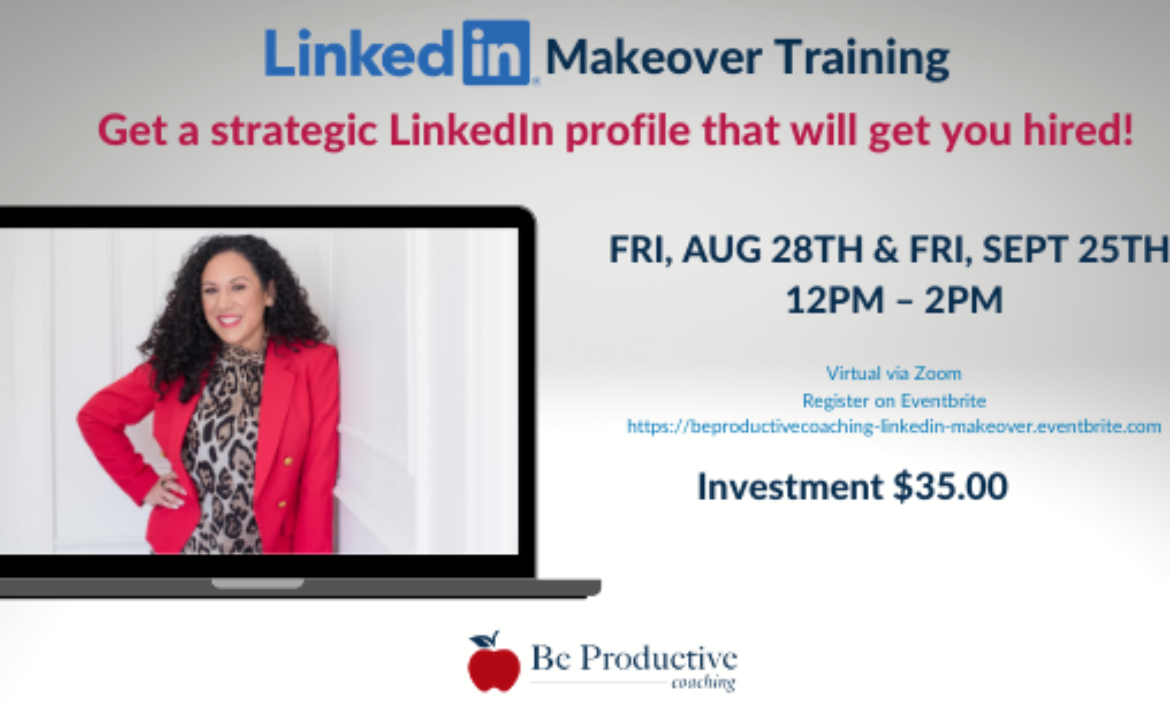
It’s time for your professional “Makeover”!

If you are currently looking for work and want to have a professional brand that sets you apart from other candidates, then this is for you!

95% of recruiters use LinkedIn to find top-notch candidates. Essentially LinkedIn is the world’s largest networking event, and yet most people have profiles that would be a horrible first impression.

We are living in unprecedented times due to COVID-19. You may have lost your job or furloughed. Now is the time to prepare by making your LinkedIn profile stand out from the crowd to land the interview you want! Your LinkedIn profile “Makeover” will be optimized to increase its visibility in search results, networking, and interview opportunities.

During our 2-hour small group virtual training you will learn the following:

• Implement practical strategies to use LinkedIn to stand out in a crowded job market.

• Learn how to use LinkedIn as an effective and strategic networking tool.

• Understand LinkedIn’s features and how to leverage them to your advantage.

• Learn how to properly build your LinkedIn profile or edit your current profile.

• Get tips on the keywords to list in your titles and work experience based on your industry.

You have two dates and times to choose from.

Sign up now!

https://beproductivecoaching-linkedin-makeover.eventbrite.com

Each training class will be limited to give you the personal attention you deserve.

This training comes with two (2) added bonuses that you will receive when you complete the training:

• The class recording via email following the training

• Training slides

Responsible-for-ensuring-active-and-engaged-communitiesaround-topics-by-managing-long-lead-editorial-calendarsand-monitoring-online-conversations.

Job Search – 10 Proactive Tactics

Challenges exist when you are in a job search. Nowadays with so many laid off or furloughed the competition is a little tighter which means that you have to be proactive in your job search.

Here are 10 proactive tactics that you can take:

  1. Professional Branding Tools: Make sure your resume and LinkedIn are aligned and that the titles, skills, and accomplishments showcased are focused on the jobs that you are applying to. This is #1 – if you don’t already have this then get this step done before you do anything else.
  2. Cover Letters: I cannot stress how important these are. Any recruiter or hiring manager can tell you how few cover letters they see. With cover letters being so rare this is a sure way to set yourself apart. Make sure you are adding value by telling them why you would be a good fit, what you love about their company or their mission, and list 3-5 things you would offer in the role you are interested in. Don’t forget to end strong and request a time to meet.
  3. Optimize Your LinkedIn Profile for Recruiters: Turn on this feature in LinkedIn and include the titles you are interested in to show recruiters that you are open to opportunities. 
  4. Turn on Job Notifications on LinkedIn: These will come to you as soon as something is posted so that you can apply immediately.
  5. Reach Out Directly: Research recruiters in your industry and reach out to them directly. You can do the same for an HR person or the actual hiring manager. If you cannot find an email then go the old fashioned way and mail them a letter with your resume.
  6. Network: Tell at least 5 people a day that you are looking for a job. Enlist your network:
    1. Your family and friends – be clear on what you are looking for: title, companies, tasks
    2. Professional contacts – people you have worked with or know through the industry.
    3. Loose connections – people you are connected to but don’t really know.
  7. Make a Short List: Identify companies you would want to work for, make a list, and target them directly even if they do not have an opening. 
  8. Find an In: Research if you know anyone at your target companies or know anyone that does. Ask for an introduction. 
  9. ATS systems: Complete the questions on the ATS systems even if you are uploading your resume.
  10. Be Prepared: You must be ready at all times. Practice your interview with a friend or family member and record yourself if you can. Know what you are going to wear and have a printed copy of your resume. 

Need more assistance or have questions? Schedule a complimentary consultation: https://beproductivecoaching.com/contact/

10 Job Search Tips to Keep Your Search Productive

These Job Search Tips Will Keep Your Search Productive Even During Covid-19

Many often say that the best time to look for a job is while you have one. But we all know that things aren’t always perfect. Many times we find ourselves having to do something unexpectedly. COVID-19 for many has proved to do that with the lay off’s and furloughs. Yet, life must go on, and the job search must continue. That job search can be a daunting task, and especially when we do not have one. Here is a shortlist of 10 tips that have helped many of my clients get back into the marketplace within just a few weeks. Note that during this pandemic, it may take a little longer, but don’t get discouraged; the show must go on, and businesses are still hiring!

  1. Get clear on your job search. Know what your ideal next step is and what positions interest you. Think about what is essential for you, i.e. money, growth, being challenged, culture, etc. (wants, needs, bonus).
  2. Polish your professional tools. Once you get clear on your strategy, it’s time to update your resume, LinkedIn profile, and also have a cover letter template ready to customize and send. No, this is not so 1989, cover letters are still required in 2020 even if they don’t ask for them.
  3. Make a list of target companies or industries. Having a strategy includes knowing what companies you want to target and industries that interest you. These will be your focus at the beginning and where you will begin your search. Remember where attention goes energy flows.
  4. Write out an action plan. How many positions will you apply for daily or per week? When and where will you start your search? What platforms will you use? Who will you contact and when?
  5. Schedule time daily. For example: Search on Indeed from 10-11 am, type cover letters from 11:30 am-12:30 pm, and apply for ten jobs from 2 pm-4 pm.
  6. Network. Use LinkedIn to get in touch with old colleagues and friends that could help you. Identify people you could connect with within your industry that may be hiring. Reach out to recruiters, email, and make phone calls, etc.
  7. Don’t forget self-care. The job search can be stressful. Take breaks, skip a day, go for a walk, exercise, journal, meditate, do anything that makes you feel good, and keeps you motivated.
  8. Keep the momentum. Consistency is key! Even when you are not in the mood. Keep going, and you will get the job eventually. It may take longer than you expected it. It may be daunting, but if you stop, you will lose momentum. Do not quit!
  9. Prepare for what’s next. Get your interview skills in order by practicing with a loved one. Be ready for an on-line zoom interview. Create a follow-up schedule (yes, you may follow up on applications). Have your thank you notes or emails available.
  10. Ask for help. If you need help with your tools or interview skills or a professional reference, do not hesitate to ask. People love helping people. Use your resources. If you do not feel comfortable asking for help, then hire a professional. Do not be afraid to invest in yourself and your career. You are not alone!


Let's Chat. Have questions or would like a free consultation?

Schedule a time that’s most convenient for you.