

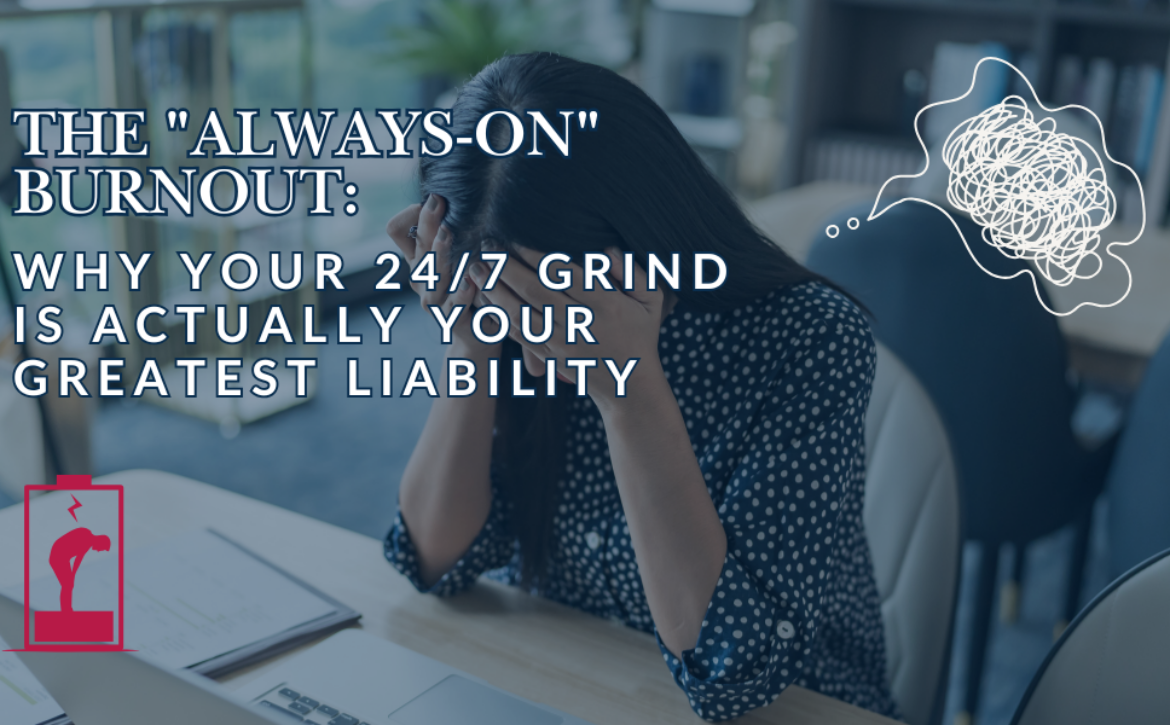
The “Always-On” Burnout: Why Your 24/7 Grind is Actually Your Greatest Liability
The “Always-On” Burnout: Why Your 24/7 Grind is Actually Your Greatest Liability
The “Always-On” Burnout: Why Your 24/7 Grind is Actually Your Greatest Liability
Let’s get one thing straight: If your “success” requires you to be tethered to a Slack channel at 10 PM on a Tuesday, you haven’t built a career, you’ve built a cage.
I see it every single day. I talk to brilliant, high-achieving leaders who have everything on paper: the title, the revenue, the influence, but they’re running on fumes and lukewarm espresso. They wear their exhaustion like a designer suit, thinking that “busy” is a synonym for “important.”
Newsflash: It’s not. It’s a slow-motion car crash.
We are living in the era of the “Always-On” Burnout. It’s that vibrating anxiety in your chest when you haven’t checked your phone in twenty minutes. It’s the guilt you feel for taking a lunch break that doesn’t involve a Zoom call. It’s the soul-crushing realization that you’re winning the game, but you’re too tired to enjoy the prize.
It’s time to stop the glorification of the grind. We need to rethink what high-stakes success actually looks like before we all collectively lose our minds.
The Lie We’ve All Bought Into: The “Hustle” Mirage
We’ve been sold this toxic narrative that the only way to stay at the top is to never, ever look away. We think that if we aren’t the first to respond, we’re replaceable. If we aren’t “hustling” while everyone else sleeps, we’re falling behind. We’ve turned “grind” into a personality trait and “rest” into a dirty word.
But here’s the truth that nobody wants to tell you: The “Always-On” model is a low-performance strategy.
When you are constantly reactive, jumping at every notification and treating every email like a five-alarm fire, you are operating from your lizard brain. You’re in survival mode. You are essentially a highly-paid firefighter who never actually puts out the fire, just keeps the smoke from getting too thick. And let me tell you, you cannot lead, innovate, or dominate your market from a place of survival.
True high-stakes success requires vision. It requires the ability to see three steps ahead, to anticipate market shifts, and to manage people with empathy and clarity. You can’t do that when your eyes are glued to a screen 18 hours a day. You’re trading your $10,000-an-hour insights for $10-an-hour busywork.
Your Brain is Not a MacBook
You can’t just keep 50 tabs open in your brain and expect the system not to crash. Your brain has a finite amount of “decision capital” every day. Every time you check a notification, answer a “quick” question, or switch tasks, you are spending that capital.
When you refuse to “turn off,” your cognitive function plummets. Your decision-making gets sloppy. You start making “good enough” choices instead of “great” ones. Worst of all, your emotional intelligence, the very thing that makes you a great leader, evaporates. You start snapping at your team, missing the nuances in a contract negotiation, and losing the “spark” that got you here in the first place.
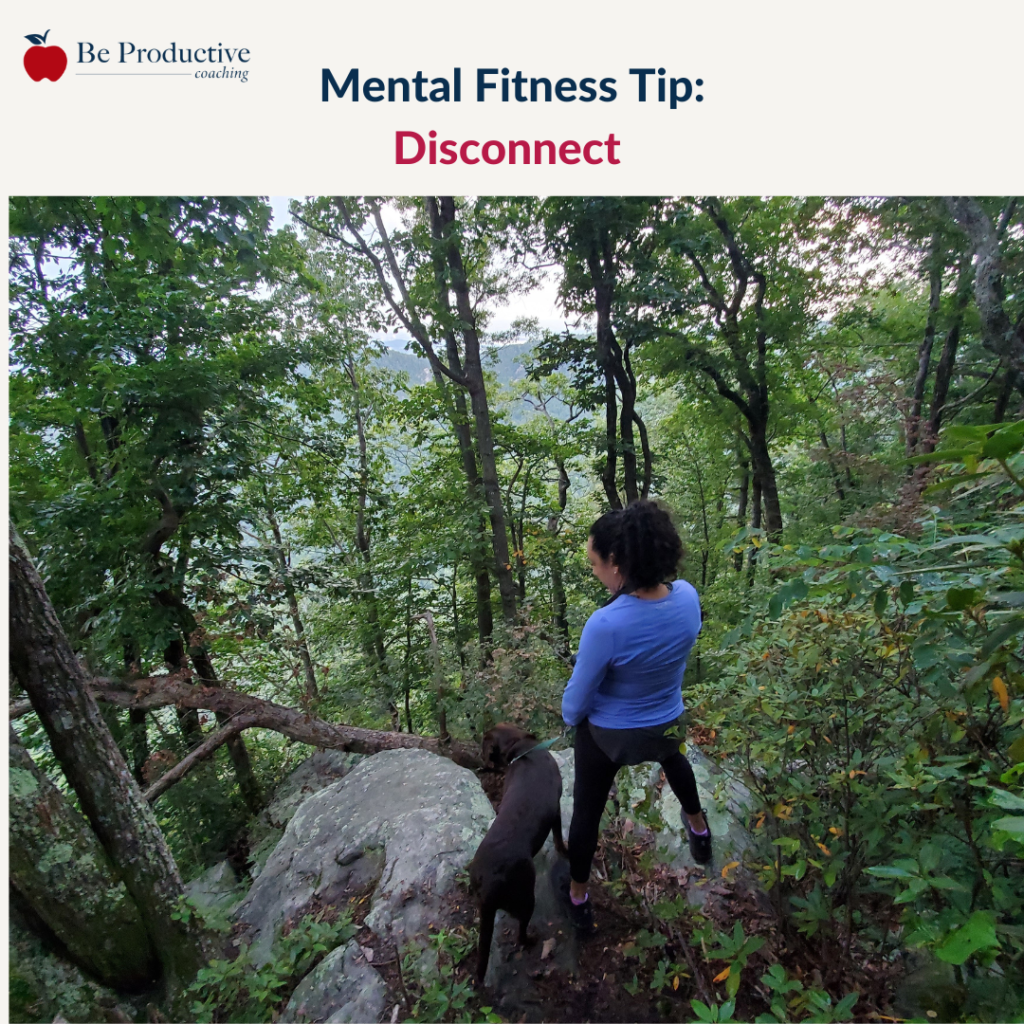
The most successful people I know aren’t the busiest. They are the most intentional. They understand that rest isn’t a reward for hard work; it’s a requirement for it. They know that a walk in the woods, a workout without a podcast, or a silent morning isn’t “wasted time,” it’s the R&D department for their next big move. If you don’t give your brain the space to wander, it will never find the solution you’re looking for.
The Psychology of the Ping
Why are we so addicted to being “on”? It’s dopamine, honey. Every time that little red bubble pops up on your screen, your brain gets a tiny hit of validation. “Someone needs me. I am important. I am productive.”
But there is a massive difference between activity and achievement.
We’ve become addicted to the feeling of being busy because it protects us from the terrifying work of being significant. It’s easy to clear an inbox; it’s hard to sit in silence and figure out why your company’s growth has stalled or how to lead a team through a crisis. We use “Always-On” as a shield against the deep work that actually matters.
3. Mental Resilience (The “Innovate” Power)
In 2026, the shelf-life of a strategy is about six months. If every shift causes you a week of stress, you’re already losing.
Mental Fitness (PQ) allows you to face a market crash, a budget cut, or a technological shift and see it as a Gift and an opportunity. While your competitors are stuck in “Judge” mode, complaining about the change, you are using your innovative power to find the loophole, the new niche, or the smarter way forward.
The Redefinition of High-Stakes Success
What if we stopped measuring success by how many hours we logged and started measuring it by the quality of our presence?
Rethinking success means acknowledging three hard truths:
- Boundaries are a Power Move: Being unavailable makes you more valuable. If anyone can reach you at any time for any reason, you aren’t a leader; you’re an intern with a better paycheck. Scarcity creates value. When you are protective of your time, people respect it more.
- Urgency is Often a Performance: Half the things people label as “urgent” are just their own lack of planning or their own anxiety bleeding onto your desk. Stop inheriting other people’s chaos. Just because someone else is panicking doesn’t mean you have to join them.
- Sustainability is the Only Real Win: If you can’t maintain this pace for the next ten years without a heart attack, a breakdown, or a divorce, your business model is broken. A “successful” life that destroys your health and your relationships is a failure of strategy.
The Cost of the “Yes”
Every time you say “yes” to a non-essential meeting or a late-night call, you are saying “no” to something else. You’re saying “no” to your sleep, “no” to your family, “no” to your health, and “no” to your long-term strategic thinking.
High-stakes success is about the Power of the No. It’s about being ruthless with your time so you can be generous with your impact.
How to Kill the “Always-On” Beast: A Tactical Guide
You don’t need a year-long sabbatical in Bali to fix this (though, hey, if you can do it, go for it). You need a backbone and a strategy. Here is how we start reclaiming your life:
1. The ”Notification Audit”
If it’s not a human being calling you with a genuine emergency, turn the noise off. Your phone should work for you, not the other way around. Most “notifications” are just companies trying to steal your attention so they can sell it to someone else. Take your attention back.
2. The Hard Stop
Pick a time, 7 PM, 8 PM, whatever, and stick to it. Put the phone in a drawer. Close the laptop. The world will not stop spinning if you don’t answer that non-critical email until tomorrow. If the world does stop spinning because you went to dinner, then you have a delegation problem, not a work ethic problem.
3. Reclaim Your Morning
Stop checking your phone the second you wake up. You are literally inviting the world’s demands, the world’s tragedies, and the world’s opinions into your bed before you’ve even had a glass of water. You are starting your day in a defensive crouch. Own your first hour. Meditate, move, read, or just stare at a wall, anything but looking at a screen.
4. Schedule “Deep Work” Blocks
If your calendar is a patchwork of 30-minute meetings, you will never accomplish anything great. You need blocks of at least 90 minutes to 2 hours where you are unreachable. No Slack, no email, no “quick questions.” This is where the magic happens. This is where you actually earn the “high-stakes” title.
5. Stop Performative Responsiveness
We often respond quickly just to show people we are working. Stop it. It sets a dangerous precedent. If you respond to an email at 11 PM, you are telling that person it is okay to email you at 11 PM. You are training people how to treat you. Train them to expect excellence, not instant accessibility.
The Leadership Ripple Effect
When you are an “Always-On” leader, you aren’t just burning yourself out, you’re burning your team out. Your behavior sets the culture. If you are sending emails at midnight, your team feels obligated to read them at midnight.
You are creating a culture of anxiety, not a culture of excellence.
A burned-out team is a stagnant team. They won’t bring you new ideas because they’re too tired to think of them. They won’t take risks because they’re too busy trying to keep up with your frantic pace.
True leadership is about creating a space where people can do their best work. And people do their best work when they feel safe, rested, and trusted. By stepping back and setting boundaries, you give your team permission to do the same. You move from a “command and control” style to a “trust and empower” style.
The Identity Crisis
Let’s talk about the elephant in the room: Who are you if you aren’t “the busy one”?
A lot of the “Always-On” burnout is driven by an identity crisis. We’ve tied our value so closely to our output that the idea of stopping feels like a disappearance. If I’m not working, do I even exist? Am I still successful?
The answer is yes. In fact, you are more successful when you have the agency to stop. Real power isn’t the ability to work 100 hours a week; real power is the ability to choose how you spend your time.
The Science of Stillness
We need to talk about why “doing nothing” is actually a high-performance habit.
There is a concept in physics called “potential energy.” It’s the energy stored in an object because of its position. A bow that is drawn back has potential energy. When you are “Always-On,” you are like a bow that is constantly being fired. You never have the chance to be pulled back, to build up that potential.
Rest is how you build potential energy. It’s how you sharpen the saw.
When you allow yourself to be bored, your brain enters the “Default Mode Network.” This is when your brain starts connecting dots that it couldn’t see when it was focused on a specific task. This is where the “Aha!” moments come from. This is where the billion-dollar ideas are born.
If you are always consuming information, you are never creating it. You need the “white space” to synthesize what you know into something new.
Redefining the Stakes
We call it “high-stakes success” because we think the stakes are the money, the title, or the market share. And sure, those things matter.
But the real stakes? The high stakes?
- Your health: Chronic stress is a literal killer. No IPO is worth a stroke.
- Your relationships: Your kids won’t remember your “productivity scores.” They’ll remember if you were there.
- Your sanity: What’s the point of having the world if you’ve lost the capacity to enjoy it?
Success is only success if you are healthy enough to experience it and have people around you to share it with. Anything else is just a well-funded tragedy.
The Bottom Line: Own Your Life
High-stakes success is about impact, not activity. It’s about being the person who makes the right call, not the person who types the most words.
You were meant for more than just being a highly-efficient processing unit for other people’s requests. You were meant to build, to lead, to innovate, and most importantly, to live.
Stop waiting for permission to slow down. The “Always-On” culture is a choice, and today is the day you opt out. You have to be the one to draw the line in the sand. You have to be the one to say, “My time is valuable, my energy is finite, and my life is more than my job.”
Reclaiming your time isn’t a retreat; it’s a strategic move. It is an investment in your longevity and the quality of your work. The world has enough people who are busy. It needs more people who are effective, centered, and truly awake.
The pressure is high, yes. But the stakes are your life, your health, and your legacy. Don’t waste them on the trivial. Don’t let the “Always-On” burnout rob you of the very success you’ve worked so hard to achieve.
Ready to Stop the Spiral?
If you’re tired of being the most stressed-out person in every room, it’s time to find out what’s actually driving your burnout. It isn’t just your calendar, it’s your internal programming.
Take the Free Saboteur Assessment Here
Discover which mental habits are keeping you “Always-On” and learn how to shift from high-stress survival to high-impact leadership. Let’s build a career that doesn’t require you to set your life on fire to keep the lights on.








 I love doing this at conferences and retreats and leaving these randomly for my husband. Buy a stack of blank “Thank you” cards or just blank cards, and for one month, mail out a minimum of one (1) card or letter per week to someone who has done something you appreciate and/or you are just grateful to have them in your life.
 The secret to this exercise is that the rock is just a symbol, a physical object you can use to remind yourself of what you have. I brought a gratitude rock back from my recent pilgrimage on the Camino as a reminder of how wonderful I felt during that trip and how grateful I am to have had the opportunity to complete the journey. The instructions are about as simple as instructions can be: just find a rock! Make sure to pick the one you like, whether you like it because it’s pretty because it is smooth or has an interesting texture, or because you picked it up from a special place. If you have another small object you’d rather use instead, feel free to substitute that for the rock. Carry this rock in your pocket, leave it on your desk where you will see it throughout your day, or even wear it on a chain around your neck or wrist. Whenever you see it or touch it, pause to think about at least one thing you are grateful